The Bharatiya Janata Party's (BJP) 'outsider' label in West Bengal, which had already been diminishing over the past one and a half years, appeared to vanish entirely as Prime Minister Narendra Modi and Union Home Minister Amit Shah began campaigning for their party candidates. Both leaders concentrated on hyper-local issues to move away from the high-decibel 'outsider' narrative that had significantly impacted the party in the 2021 assembly elections.
Shift in Campaign Strategy
The change in narrative became evident when Modi launched his campaign in Bengal in June last year. In July 2025, during a rally in Durgapur, he began with a 'Jai Ma Kali, Jai Ma Durga' homage, promising to uphold the BJP's commitment to Bengal's cultural and industrial development. In February, Modi again marked his campaign with a tribute to 'Maa Kali'. The Prime Minister had also sent a letter to voters in Bengal, urging them to vote for change, which started with a prayer to the Goddess. This evolving narrative resonated when Delhi Chief Minister Rekha Gupta and Union Minister Annapurna Devi addressed gatherings in Kolkata.
Intensive Campaigning
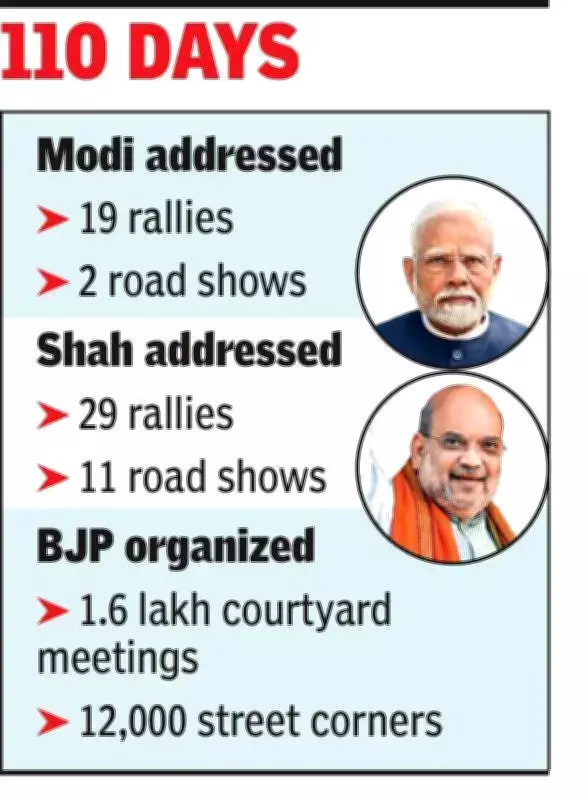
Over the past couple of months, Modi held 19 rallies and two road shows across 42 organisational districts in Bengal, while Shah conducted 29 rallies and 11 road shows in 39 organisational districts. Fish emerged as a central political narrative, with Modi focusing on a 'fish project' to boost local production. This food-centric campaign helped counter the Trinamool Congress's claims that the BJP would restrict non-vegetarian diets in Bengal. Images of central BJP leaders eating fish were widely circulated, and Assam Chief Minister Himanta Biswa Sarma challenged Mamata Banerjee to a fish-eating contest. Several BJP candidates even campaigned with a fish in hand.

Cultural Outreach
In March, Modi spoke about Bengali 'asmita' (pride) and posted a Shyama Sangeet, a song written by Ramprasad. During his rallies, Shah invoked Bengal icons from various socio-cultural fields. The BJP, riding the wave of the 150th year of Vande Mataram, fielded Soumitra Chattopadhyay, a descendant of Bankimchandra Chattopadhyay, as a candidate. Shah mentioned Rabindranath Tagore and Swami Vivekananda to establish the party's cultural roots in Bengal, often claiming these icons were 'neglected' by previous governments.
Local Engagement
Shah positioned the BJP as a party that would empower the people of Bengal and protect its cultural and historical ethos, accusing the Trinamool Congress of only trying to 'protect infiltrators'. He even announced that the next chief minister would be a 'son of the soil'. In his last visit, Modi stopped at a jhalmuri stall in Jhargram and enjoyed a packet of muri, demonstrating his familiarity with Bengal's street culture. He also took a boat ride on the Hooghly River and visited Thanthania Kalibari. After the campaign, he went to Sikkim, where he played football, reminding Bengal of its favorite sport.