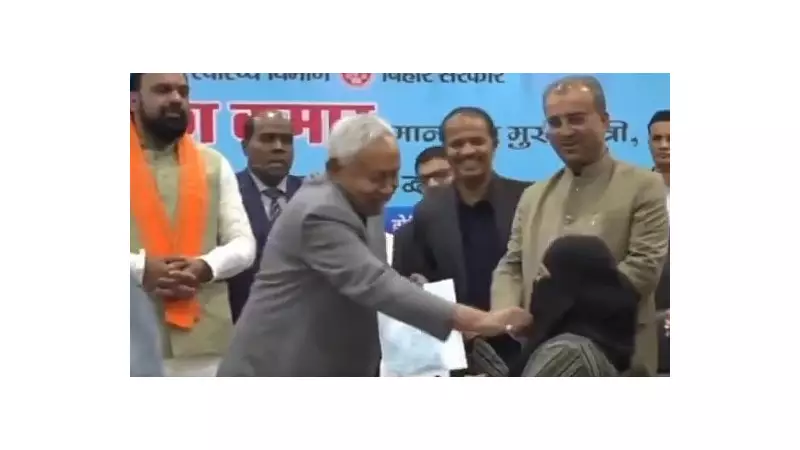
A public function in Patna meant to celebrate the appointment of new government doctors took a controversial turn when Bihar Chief Minister Nitish Kumar physically removed the hijab from a female doctor's head. The incident, which occurred on Wednesday, has ignited a fierce political debate and drawn widespread condemnation.
The Incident at the Government Event
The event was organized at the Samrat Ashok Convention Centre in Patna, where CM Nitish Kumar was distributing appointment letters to 701 newly recruited doctors for primary health centres across Bihar. During the ceremony, as the Chief Minister was interacting with the recruits on stage, he approached one doctor who was wearing a hijab.
In a moment captured on video and widely circulated, Nitish Kumar is seen reaching out and pulling the hijab off the doctor's head. He then appeared to gesture towards her hair, seemingly asking her to keep her head uncovered. The doctor, identified as Dr. Saba Anwar, looked visibly startled and uncomfortable but did not immediately protest. She later covered her head again after the CM moved away.
The incident happened on Wednesday, February 26, 2025, during a high-profile government program aimed at highlighting the state's healthcare recruitment drive.
Immediate Reactions and Political Fallout
The action by the Chief Minister triggered immediate and strong reactions from opposition parties and social commentators. The Rashtriya Janata Dal (RJD), the main opposition party in Bihar, was quick to condemn the act. RJD leader Tejashwi Yadav accused Nitish Kumar of violating the doctor's personal freedom and religious rights.
"This is an outright attack on personal liberty and religious expression," a senior RJD spokesperson stated. "A Chief Minister has no right to forcibly remove anyone's religious attire. It shows a complete disregard for the dignity of an individual, that too a professional woman who just joined government service."
Other political voices and civil society groups echoed this sentiment, calling the act "highly inappropriate" and "an overreach of authority." Critics argued that it sent a wrong message in a diverse society like India's, where the right to practice one's religion is constitutionally protected.
Government's Stance and Broader Context
As of now, there has been no official statement or apology from Chief Minister Nitish Kumar or his office regarding the incident. Supporters of the Chief Minister and his party, the Janata Dal (United), have attempted to downplay the event, suggesting it was a casual, non-malicious gesture.
Some allies within the ruling National Democratic Alliance (NDA) have remained silent on the issue, highlighting the delicate political optics. The incident comes at a time when debates around religious symbols in public spaces and personal choice remain highly sensitive in Indian politics.
The newly appointed doctor at the centre of the storm, Dr. Saba Anwar, has not made any public statement about her feelings regarding the incident. Her silence has further fueled discussions about the power dynamics at play and the pressure on a new recruit facing such a situation from the state's highest authority.
This controversy threatens to overshadow the positive news of the mass recruitment of doctors, which was the original purpose of the event. The Bihar government had intended to showcase this as a major achievement in strengthening the public health infrastructure.
The episode raises significant questions about the boundaries of a public figure's interaction with citizens and the respect for individual autonomy. It remains to be seen whether this incident will have lasting political repercussions for Nitish Kumar in Bihar or influence the broader national discourse on similar issues.