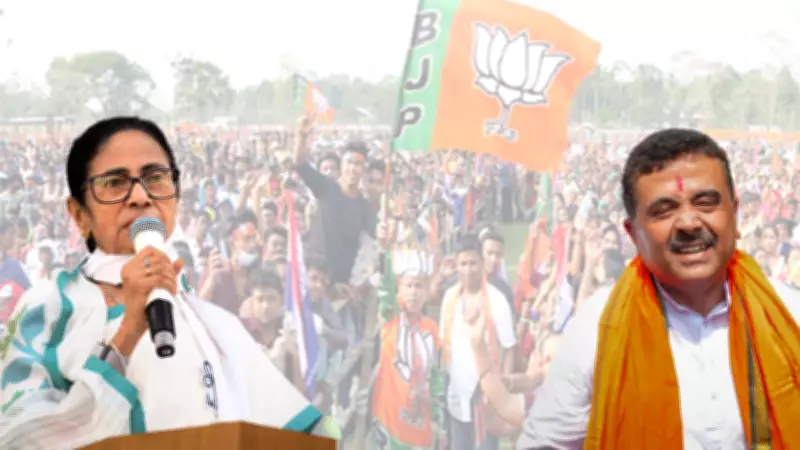
Bhabanipur: From TMC Fortress to Political Battleground as BJP Repeats Nandigram Strategy
Bhabanipur, historically regarded as Mamata Banerjee's most secure political territory, is now stirring uneasy comparisons with Nandigram. In the 2021 assembly elections, Banerjee's decision to contest from Nandigram resulted in a dramatic setback when Suvendu Adhikari defeated her in a high-stakes battle. This outcome reshaped the narrative of the polls and marked a symbolic breakthrough for the Bharatiya Janata Party in West Bengal.
Redrawing Battle Lines in Urban Bengal
Five years later, the BJP appears to be implementing a similar strategic approach, this time targeting Bhabanipur. By nominating Adhikari as their candidate, the BJP has effectively transformed what was once considered a safe seat into a high-pressure contest. This move carries deep symbolic significance, directly challenging Banerjee's authority in the very constituency that has repeatedly ensured her political survival.
For the chief minister, Bhabanipur represents more than just another electoral district. It is where she rebuilt her mandate following the Nandigram defeat. Now, this crucial constituency risks becoming a stage where history might repeat itself.

Parallels Between Nandigram and Bhabanipur
The political parallels are difficult to overlook. Just as Nandigram became a referendum on Banerjee's leadership in 2021, Bhabanipur is shaping up as a test of her enduring influence over urban Bengal. The central question looming over this contest is whether the BJP has successfully recreated a similar political trap, or whether Banerjee can once again transform a moment of vulnerability into a decisive comeback.
Bhabanipur's transformation from a Trinamool Congress bastion to a competitive seat reflects shifting political currents across West Bengal. In the 2021 bypoll, Banerjee secured over 71 percent of the vote, defeating BJP candidate Priyanka Tibrewal by a margin exceeding 58,000 votes. However, recent electoral trends suggest emerging cracks in that dominance.
Changing Electoral Dynamics and Demographics
During the 2024 Lok Sabha elections, the TMC's lead in the Bhabanipur segment narrowed to approximately 6,500 votes, while the BJP made significant gains across several municipal wards. This changing landscape has prompted internal party meetings reflecting a sense of urgency within TMC ranks.
TMC national general secretary Abhishek Banerjee has established an ambitious target of winning Bhabanipur by over 60,000 votes and has cautioned party cadres against complacency. The constituency's evolving demographics add further complexity to the electoral equation.
With roughly 76 percent Hindu voters divided between Bengali and non-Bengali communities and 24 percent minority voters, Bhabanipur represents a microcosm of urban Kolkata. Migrant populations from Uttar Pradesh, Bihar, and Odisha further influence electoral behavior, making outcomes less predictable than in previous elections.
Special Intensive Revision Controversy
A key flashpoint in the current contest involves the Special Intensive Revision of electoral rolls. According to party sources, over 40,000 names have been deleted from voter lists, with thousands more under adjudication. This development has triggered a significant political controversy.
Banerjee has accused the central government, led by Prime Minister Narendra Modi, of interfering in West Bengal's electoral process. She has warned that administrative changes could compromise poll fairness and has promised legal support to voters whose names may have been improperly removed.
The available data presents a complex picture. While a substantial portion of deleted voters belong to non-minority communities, a significant proportion of those under scrutiny are from minority backgrounds. Combined, these figures indicate an almost even split, fueling competing narratives from both political sides.
Historical Significance and Political Evolution
Adding to the electoral uncertainty is Ward 77, once considered a TMC stronghold due to its substantial minority voter base. Political observers now describe this ward as fluid, suggesting that even traditional vote banks may not remain entirely secure.

Bhabanipur's political importance extends beyond current electoral calculations. Once a Congress bastion represented by leaders like Siddhartha Shankar Ray, the constituency has mirrored Bengal's political evolution over several decades.
After disappearing from the electoral map in 1972 due to delimitation, Bhabanipur was revived in 2011—the same year Banerjee ended the Left Front's 34-year rule in West Bengal. Since that revival, the seat has been intimately connected to her political journey.
Current Political Landscape and Future Implications
From her bypoll victory in 2011 to her return in 2021 following the Nandigram defeat, Bhabanipur has repeatedly served as both fallback option and political fortress for the chief minister. However, the BJP's decision to field Adhikari in this constituency marks a significant turning point in West Bengal politics.
Fresh from filing nominations in Nandigram and projecting confidence about victory prospects, Adhikari has framed the Bhabanipur contest as part of a broader push for what he describes as a corruption-free government in West Bengal.
As West Bengal prepares for a two-phase election in April, with vote counting scheduled for May 4, Bhabanipur stands at the center of the political storm. What was once considered a safe seat has now become a crucial test of resilience for Mamata Banerjee and a potential launchpad for the BJP's expanding ambitions in Kolkata and urban Bengal.