Assam Chief Minister Defines Eviction Targets, Accuses Opposition of Appeasement
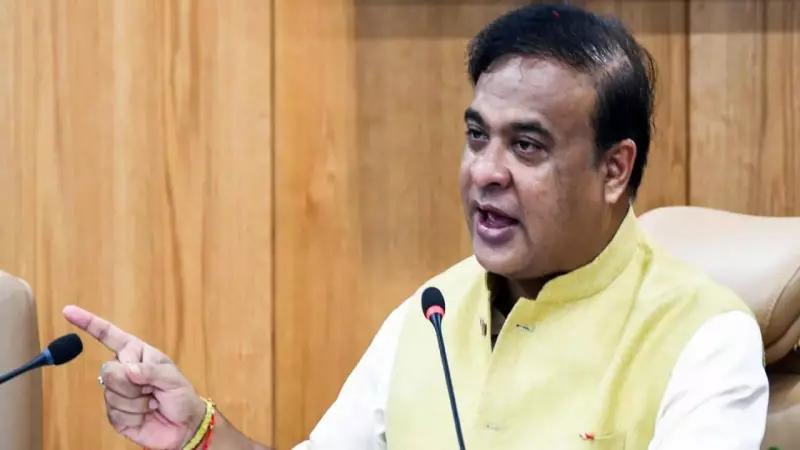
In a significant statement that has stirred political discourse in Assam, Chief Minister Himanta Biswa Sarma asserted on Sunday that the state's eviction drives have been specifically directed at "Miyas"—a term commonly used for Bengali-speaking Muslims—while indigenous Assamese communities remain unaffected. The comments come amid heightened political tensions ahead of the upcoming Assembly elections, scheduled for the first half of this year.
Clarification on Guwahati Hills Eviction Reports
Addressing media representatives, Sarma categorically dismissed circulating reports about a proposed eviction operation in the hills surrounding Guwahati. He provided a firm assurance that no such action would be undertaken in the area until after the elections. "Only Miyas are evicted in Assam. How can Assamese people be evicted?" he questioned, thereby attempting to allay concerns regarding alleged anti-encroachment measures in the Guwahati hills.
Elaborating further, the Chief Minister emphasized, "Till election, when not a single eviction will happen, then people residing in the hills will understand that it was the media which gave them tension." He highlighted the track record of the BJP-led government, which has been in power in the state for nearly a decade, and challenged claims of selective evictions by asking, "The BJP has been in power in the state for 10 years now. Where has eviction been carried out in Guwahati hills?"

Land Rights Initiative and Continued Focus on 'Miyas'
Contrary to eviction fears, Sarma revealed that the government is actively working to grant land rights to residents of the hills without imposing any premium charges. However, he maintained a clear distinction in policy, stating that eviction notices would indeed be served to any Miya individuals found residing in the hills, while Assamese people would be exempt from such actions.
Sharp Criticism of Congress and Allegations of Community Bias
Launching a vigorous attack on the opposition, particularly the Congress party, Sarma accused them of disproportionately focusing on the Bengali-speaking Muslim community in their electoral strategies. He pointed to the party's ticket applications, claiming, "The Congress has said that it has received 750 applications from prospective candidates seeking party ticket. But what they didn't say is that 600 of these applicants are Miyas. Only about 120-130 applicants are Hindus."
Using sarcasm to underscore his point, Sarma added, "There has been a 'Miya ujan' in Rajib Bhawan," alleging that the Congress state headquarters was being inundated by members of the community. He framed the Congress as a threat to Assam's social and cultural fabric, asserting, "The Congress party has become a threat to our religion, culture, and the more convincingly we defeat them, the more we can save our state and 'jati'." He further alleged that opposition parties would unite in the elections primarily "for the sake of the Miyas".
Upcoming Revelations on Pakistan Links Allegation
In a related development, Sarma announced that details concerning alleged Pakistan connections involving Assam Congress president and Lok Sabha MP Gaurav Gogoi would be made public shortly. "I want to reveal it by January 31. But since there is the Union Budget on February 1, there might be a delay by a day or two," he stated.
The BJP and Sarma have previously targeted Gogoi over allegations related to his wife's purported links with Pakistan's intelligence agency, the ISI. The Assam government had constituted a Special Investigation Team (SIT) to probe alleged interference by Pakistani national Ali Tauqeer Sheikh, who was claimed to have connections with Gogoi's British wife, Elizabeth Colburn. The SIT submitted its report to Sarma, who also holds the Home portfolio, on September 10.
The term 'Miya', traditionally used as a reference to Bengali-speaking Muslims in Assam—often labeled by non-Bengali-speaking groups as Bangladeshi immigrants—has in recent years been reclaimed by sections of the community as an assertion of identity. Sarma's remarks have thus ignited a fresh debate on identity, migration, and political strategy in the electorally crucial state of Assam.