1986 Punjab-Haryana Talks End in Deadlock Over Chandigarh Village Transfer
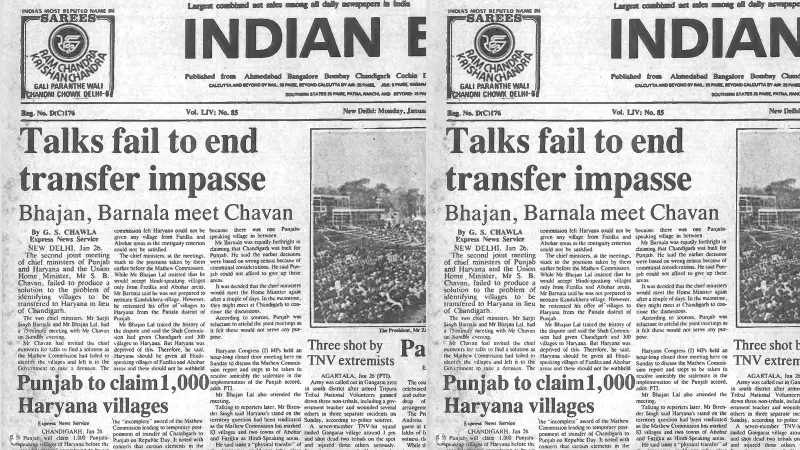
On January 27, 1986, a critical meeting aimed at resolving the long-standing territorial dispute between Punjab and Haryana concluded without any breakthrough. The second joint meeting involving the chief ministers of both states and the Union Home Minister, S B Chavan, failed to produce a solution for identifying villages to be transferred to Haryana in exchange for Chandigarh.
Stalemate in High-Level Discussions
The discussions, which lasted for 75 minutes, saw Punjab Chief Minister Surjit Singh Barnala and Haryana Chief Minister Bhajan Lal sticking firmly to their previously stated positions before the Mathew Commission. This impasse highlighted the deep-rooted complexities of the Chandigarh issue, which has been a point of contention since the reorganization of states in 1966.
Punjab's Demand for 1,000 Villages
In a related development, Chief Minister Surjit Singh Barnala announced that Punjab would claim 1,000 Punjabi-speaking villages from Haryana before the upcoming second territorial commission. This commission is to be established under the memorandum of settlement between Prime Minister Rajiv Gandhi and Harchand Singh Longowal. Barnala specified that these villages are located in the districts of Sirsa, Hissar, Kurukshetra, and Ambala, emphasizing the linguistic and cultural ties as a basis for the claim.

Broader National and International Context
While the Punjab-Haryana talks dominated domestic headlines, significant events were unfolding internationally and in other parts of India. In Uganda, the rebel National Resistance Army (NRA), led by former defence minister Yoweri Museveni, successfully took over the capital, Kampala, after a nine-day offensive. Western diplomatic sources reported that the NRA was clearly in control, with residents greeting the guerrilla takeover with jubilation, and the city remaining quiet overnight except for sporadic shooting.
On the home front, it was officially announced in New Delhi that the budget session of Parliament would commence on February 17. President Zail Singh is scheduled to address the joint session of both Houses on the opening day, setting the stage for key legislative discussions.
These events from January 27, 1986, underscore a period of intense political negotiation and regional conflict, with the failure of the Punjab-Haryana talks reflecting the ongoing challenges in Indian federalism and border disputes.