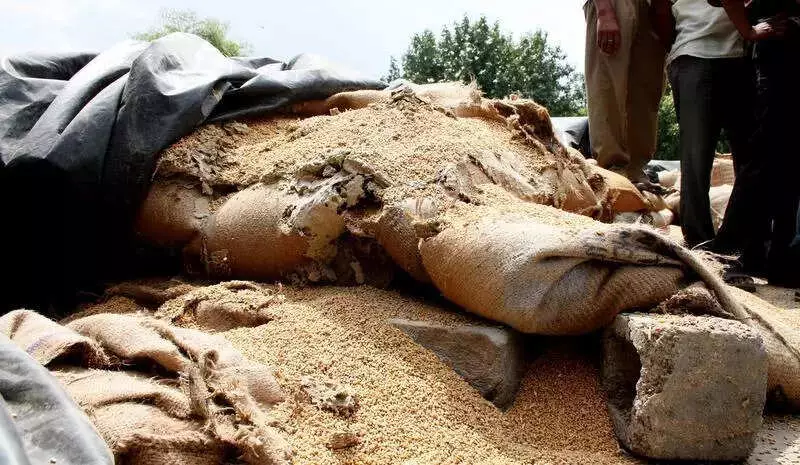
In a startling revelation that underscores systemic failures in food storage, Punjab, celebrated as the nation's granary, has recorded the maximum damage to foodgrains held in Food Corporation of India (FCI) stocks across India over the last five years. The state witnessed a staggering loss of 7,746 metric tonnes (MT) in the financial year 2023-24 alone, far exceeding the figures of any other state.
Parliamentary Data Reveals Alarming Figures
The grim statistics were placed on record in the Lok Sabha by the Union Ministry of Consumer Affairs, Food and Public Distribution. The data was provided in response to a question raised by Delkar Kalaben Mohanbhai, the Member of Parliament from Dadra and Nagar Haveli. The ministry's state-wise assessment paints a concerning picture of food security management.
According to the official reply, Punjab's cumulative foodgrain loss over the five-year period from 2020-21 to 2024-25 stands at a massive 8,226.04 MT. This total is overwhelmingly driven by the catastrophic losses in the single year of 2023-24. The state's damage in other years was significantly lower: 25 MT (2020-21), 100 MT (2021-22), 264 MT (2022-23), and 91.04 MT (2024-25).

This massive spoilage occurs despite Punjab having a substantial storage infrastructure. The state's overall storage capacity is 174 lakh MT, which includes 124 lakh MT under the FCI and another 49 lakh MT with state agencies. The escalating spoilage highlights critical gaps in the existing systems, pointing to an urgent need for stronger storage mechanisms, tighter oversight, and greater accountability to prevent such avoidable losses.
Other States Also Report Significant Losses
While Punjab's numbers are the most severe, several other major agricultural states reported sizeable damages to their food stocks in recent years, as per the Lok Sabha data.
- Tamil Nadu reported the second-highest recent loss, with 3,001.39 MT damaged in 2024-25, bringing its five-year total to 3,008.39 MT.
- Haryana saw a significant single-year loss of 2,511 MT in 2023-24.
- Uttar Pradesh registered a loss of 2,254.32 MT in 2024-25, taking its cumulative figure to 2,450.32 MT.
- Maharashtra accumulated 2,856.68 MT of damaged stock over five years, with the highest (1,985.68 MT) occurring in 2024-25.
- Odisha reported a total of 1,157 MT, mostly from a single year (1,145 MT in 2020-21).
Commodity-Wise Damage and Financial Impact
The ministry also provided a detailed commodity-wise breakdown of the damaged wheat and rice, along with their valuation. The data reveals not just the physical waste but also the substantial financial cost borne by the exchequer.
The highest recorded value of damaged foodgrains in this period was for rice in 2024-25, amounting to Rs 13.06 crore. This was linked to 0.072 lakh tonnes of damaged stock against an offtake of 259.55 lakh tonne, translating to a loss percentage of 0.028%. For the previous year (2023-24), rice damage was valued at Rs 2.06 crore.
Wheat losses, though comparatively lower in volume, also resulted in crores of rupees going to waste. Damages were recorded as 0.01 lakh tonnes (Rs 0.64 crore) in 2020-21, 0.004 lakh tonnes (Rs 0.46 crore) in 2022-23, and 0.0067 lakh tonnes (Rs 0.814 crore) in 2024-25.
The recurring theme from this parliamentary data is clear: India's public food storage system requires an immediate and comprehensive overhaul. As the country strives for food security for its vast population, preventing the spoilage of harvested grains in government godowns is as crucial as boosting agricultural production itself. The figures from Punjab, the nation's food bowl, serve as a particularly stark warning.