New Delhi has witnessed a grim milestone on its roads this year, with official data recording more than 1,100 fatal accidents by the end of October. While speeding is often the cited culprit in police reports, a ground investigation reveals a more insidious, everyday danger contributing to the chaos: the city's confusing, missing, and poorly maintained road signage.
The Invisible Signs of Danger
Drivers in the capital are familiar with the sudden, heart-stopping brake slams that are not always born of recklessness. Often, they are a desperate reaction to a diversion that appears out of nowhere, a turn hidden behind overgrown branches, or a signboard placed so awkwardly that it becomes visible only when it's too late to react safely. In a metropolis where road layouts can change overnight, this inconsistency in signage forms a thin, dangerous line between a smooth journey and a catastrophic crash.
The rules for proper signage are clearly defined. The Indian Roads Congress (IRC) codes specify precise placements: most signs must face oncoming traffic at right angles, with allowances for glare or curves. Critical signs like 'Give Way' must be positioned 25-50 metres before an intersection, accompanied by clear road markings. However, a reality check across key Delhi stretches—from Noida Link Road to Ring Road—paints a starkly different picture.

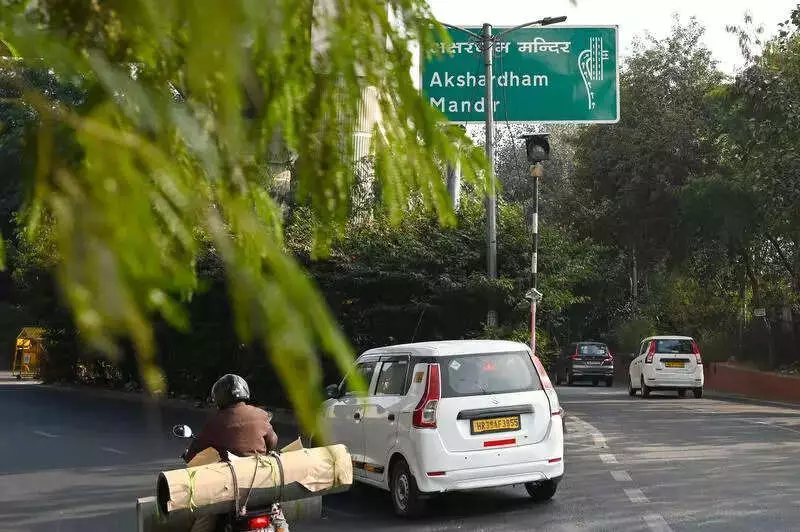
On the ground, regulatory and warning signs, which should be prominently placed on the left, are found swinging backwards, sinking into bushes, or hiding behind dense foliage. On Nelson Mandela Marg near Vasant Vihar, a diversion board is pushed far onto the cycle track, easily missed. Just metres away, a sign for a U-turn to Vasant Kunj is almost entirely swallowed by shrubbery.
Experts Decode the Systemic Failure
This systemic neglect has severe consequences, say traffic safety experts. Rohit Baluja, Director of the Institute of Road Traffic Education, points out that while police FIRs frequently blame speed, the root cause is often missing infrastructure. He estimates that nearly 70% of Delhi's road signage is either missing or substandard, a direct violation of Central Motor Vehicles Rules that mandate adherence to IRC codes.
"Speed-limit signs should appear after every junction, but they are mostly installed only near enforcement cameras," Baluja explained. "U-turns, uncontrolled pedestrian crossings, and road priorities need clear warnings. When these devices are absent or faulty, the hazard level increases dramatically."
The danger is particularly acute at U-turn points, which behave differently from traditional intersections. S Velmurugan, chief scientist at CSIR-CRRI's traffic engineering division, emphasizes the need for basic speed-management measures like Transverse Bar Markings (TBMs). These are a series of white lines painted across lanes in a descending sequence—starting 180 metres before the turn—to visually cue drivers to slow down.
"A designated U-turn reduces conflict points compared to an intersection, but drivers naturally speed up," Velmurugan said. "TBMs become essential. Yet, on many stretches, especially near flyovers, these required markings are either absent or barely visible."
A City Playing Catch-Up
The Public Works Department (PWD), responsible for permanent signage, stated that the process of sign placement is ongoing and tenders have been issued recently. Pruning vegetation that obscures signs is also part of the plan, but officials note that obtaining necessary permissions from bodies like the National Green Tribunal can often cause delays.
Meanwhile, temporary boards put up by the Delhi Traffic Police attempt to fill the gaps, creating a patchwork and often confusing guidance system for millions of daily commuters. The investigation found consistent issues: on Vikas Marg, new U-turn signs are too small, text-heavy, or hidden under hedges. Near ITO, direction boards lean back, partially obscured by branches and placed too close to the median to be read at normal speeds.

The conclusion from the surveyed stretches is unmistakable: Delhi's signage network is inconsistent, under-maintained, and often invisible. As the city grapples with its road safety crisis, fixing this overlooked factor could be a crucial step in preventing panic stops from turning into fatal collisions.