Centre's Deregulation Push: Scrap Land Use Permissions, States Told
The Cabinet Secretariat's deregulation cell has formally requested state governments to consider abolishing the mandatory requirement for 'Change in Land Use' (CLU) permissions and to significantly relax existing zoning regulations. These sweeping proposals form a crucial component of the Central government's ambitious 'Compliance Reduction and Deregulation: Phase II' initiative, which is squarely aimed at enhancing the ease of doing business across India.
Core Recommendations for Regulatory Overhaul
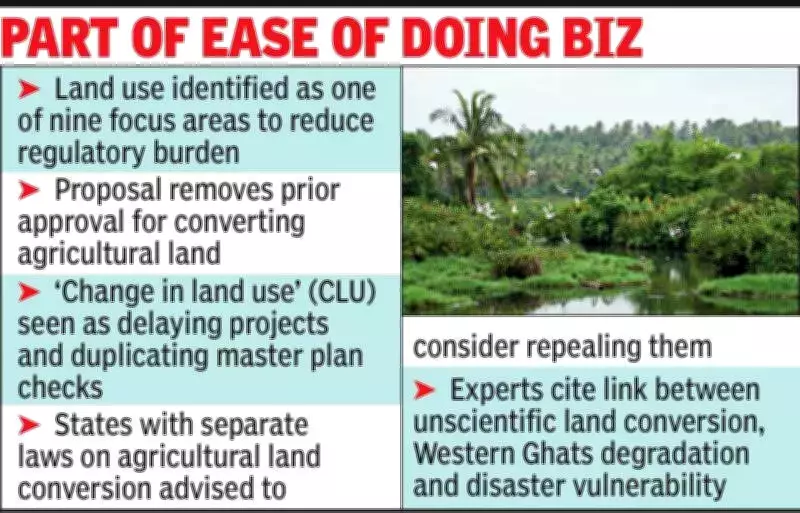
A pivotal recommendation is the complete removal of the obligation for landowners to seek prior approval for converting agricultural land to non-agricultural purposes. The deregulation cell's presentation argues that, despite procedural simplifications and digitization efforts, the CLU mandate continues to be a major bottleneck, causing substantial project delays and adding unnecessary layers of bureaucratic compliance.
The cell contends that the financial burden of conversion is already shouldered by landowners, often farmers, and that the permission process merely duplicates checks that are adequately addressed under approved master plans. It has, therefore, suggested that states with standalone laws governing agricultural land conversion should consider repealing them entirely, citing Andhra Pradesh as a successful precedent.

For states where such provisions are embedded within revenue codes or tenancy legislation, the recommendation is to excise those specific sections. In instances where both types of laws exist, the advice is to delete all provisions that necessitate CLU permission.
Proposed Shift in Zoning Philosophy
The deregulation cell has also put forward radical changes to conventional zoning practices. It notes that many states currently categorize land strictly into residential, commercial, and industrial zones, allocating only a minimal share—typically between 3% and 5%—for mixed-use development.
Instead, it advocates for a fundamental paradigm shift: adopting a 'permitted unless prohibited' model. Under this streamlined approach, all activities within a designated zone would be allowed by default, with only a concise 'negative list' of specifically banned uses. A parallel suggestion has been made for building regulations to actively encourage mixed-use urban development.
To safeguard state revenues, the proposal includes a provision for collecting a fixed conversion charge or fee without mandating a separate, time-consuming approval process, particularly in areas already covered by an approved master plan.
Kerala's Complex Environmental Context
These proposals carry profound and potentially contentious implications for Kerala, where land use is intricately and tightly regulated through a complex legal framework linked directly to environmental protection. The state's context is governed by statutes like the Kerala Conservation of Paddy Land and Wetland Act, 2008, which was enacted precisely to prevent the large-scale conversion of ecologically critical paddy fields and wetlands.
A senior official from the Kerala Revenue Department emphasized that the state's reality is "fundamentally different" from the deregulation framework envisioned by the Centre. "In Kerala, land use cannot be viewed solely through the narrow lens of ease of doing business," the official stated. "Our wetlands and paddy fields are vital environmental resources. The state has endured repeated floods and devastating landslides in recent years. There is a direct and established link between unscientific land conversion, the degradation of the Western Ghats, and our increased vulnerability to natural disasters."
Echoing these concerns, noted environmentalist Sridhar Radhakrishnan warned that Kerala cannot afford any further dilution of its land safeguards while it is still grappling with the severe consequences of past unscientific land use. "What Kerala urgently requires is a comprehensive, scientifically-grounded land use policy rooted in principles of sustainability and environmental science," Radhakrishnan asserted. "Dismantling essential regulatory checks merely in the name of expedited development is not a viable or responsible solution for our state's future."

The Centre's push for deregulation thus sets the stage for a significant policy debate, pitting the objectives of business facilitation and reduced red tape against Kerala's imperative for stringent environmental conservation and disaster risk mitigation.