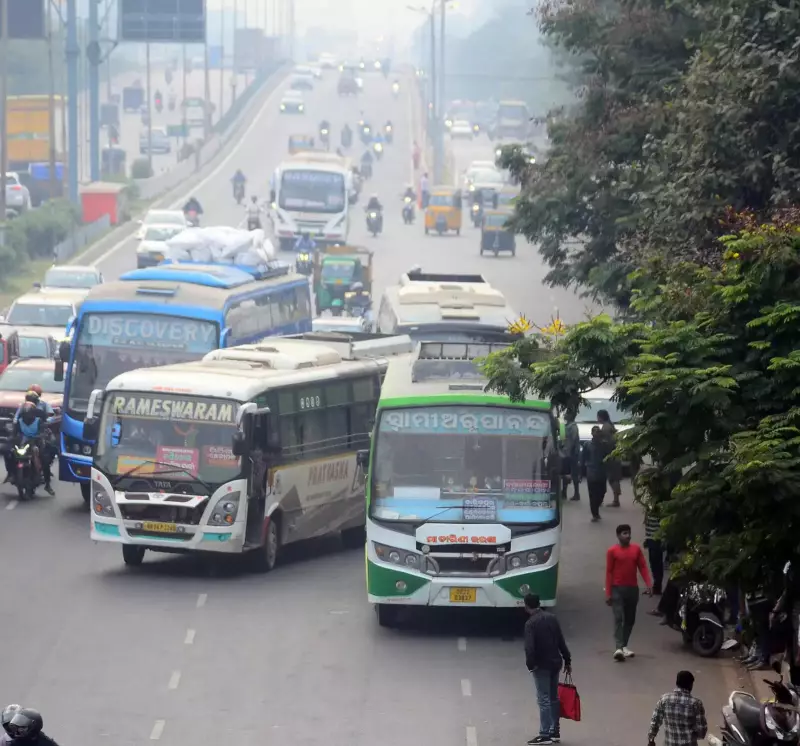
The chaotic and unregulated stopping of passenger buses along National Highway-16 within Bhubaneswar's city limits is causing massive public inconvenience and posing grave safety threats. This persists despite the existence of properly designated bus stops at key junctions, turning the highway into a hazard zone for thousands of daily commuters.
Shocking Survey Reveals Alarming Patterns
A revealing 2024 survey conducted by the Bhubaneswar Development Authority has laid bare the dangerous operational patterns of buses on NH-16 and the Puri bypass. The study found that buses halt at an average interval of just 576 metres on NH-16, a distance far shorter than recommended spacing. More alarmingly, many of these stops happen right in the middle of the carriageway.
Over a single 24-hour monitoring period, the survey recorded that a staggering 4,650 buses made an incredible 17,132 halts across these two crucial corridors. These stops occurred at 77 identified locations, a significant number of which are completely unauthorized. The report explicitly warned that such erratic and frequent stoppages severely disrupt the flow of mixed traffic and exponentially increase risks for pedestrians and two-wheeler riders.

Commuters' Nightmare and Crumbling Infrastructure
For daily travelers, the situation is a daily ordeal. Bhavna Mohanty, a regular commuter on NH-16, described the peril. "Buses suddenly swerve from the right lane to the left to stop, leaving cars behind scrambling to avoid collisions. It is an absolute nightmare during peak hours," she said. The problem is worsened by neglected infrastructure. Several official bus shelters along the highway stand abandoned or are placed away from where buses actually stop. This forces passengers to wait under the scorching sun or heavy rain while buses halt at undesignated points further down the road, prompting local demands to relocate shelters to these actual stopping points.
Calls for Urgent Intervention and Enforcement
Transport and safety experts are calling for immediate action. Syed Maqbool Ali, a former member of the National Road Safety Council, emphasized strict adherence to Indian Road Congress guidelines for bus stop design and robust enforcement. "If stops are properly planned and drivers are sensitised, these problems will vanish. The survey findings must be shared with authorities to devise a concrete solution," Ali stated. However, a key enforcement hurdle exists. Suraj Singh, the NHAI project director for the Bhubaneswar circle, acknowledged the urgency but pointed out a limitation. "Our team patrols the highway, but we lack the power to penalize violators," Singh said, adding that they will formally request the commissionerate police to intervene and take strict action against offending bus operators.
The core issue revolves around private intercity and interstate buses frequently stopping at undesignated points to pick up and drop off passengers. This practice creates sudden traffic bottlenecks and dramatically increases the likelihood of accidents, with pedestrians being the most vulnerable. Without coordinated action between transport authorities, traffic police, and bus operators, the safety crisis on NH-16 is set to continue, jeopardizing lives daily.