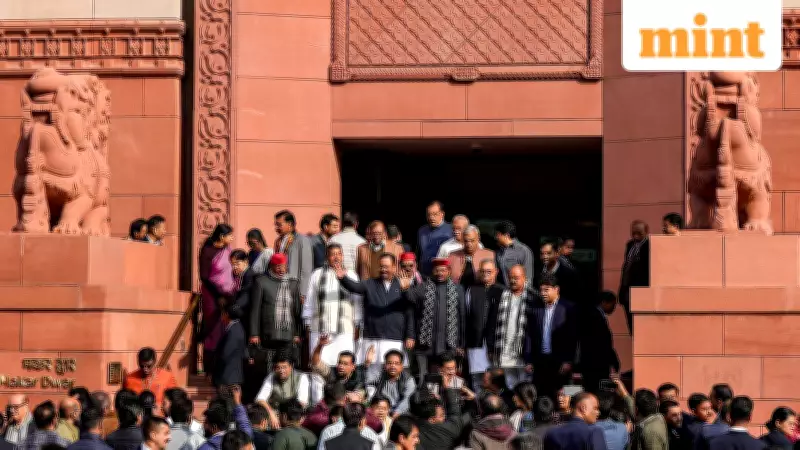
Parliament Set for Intense Budget Debate Amidst Opposition Protests
Both Houses of Parliament are scheduled to commence discussions on the Union Budget for the fiscal year 2026-27 on Monday. This critical debate follows a tumultuous week where parliamentary proceedings were repeatedly adjourned due to vigorous protests by opposition members in both the Lok Sabha and the Rajya Sabha.
Budget Presentation and Key Proposals
Finance Minister Nirmala Sitharaman presented the Union Budget 2026-27 in the Lok Sabha on February 1, marking her ninth consecutive budget presentation. In her address, she emphasized that the budget is driven by "Yuvashakti" and founded on "three kartavyas". Significant proposals include the development of seven high-speed rail corridors, the establishment of new dedicated freight corridors, and the operationalization of 20 national waterways over the next five years.
Additionally, the government announced an increase in the Securities Transaction Tax on futures and options trading. This measure is intended to discourage speculative trading activities in the financial markets.

Opposition Protests and Parliamentary Disruptions
Last week, the Lok Sabha passed the Motion of Thanks by a voice vote, notably without Prime Minister Narendra Modi's customary reply. This occurred amidst uproar from the Opposition concerning the Indo-U.S. trade deal and allegations that the Chair prevented Leader of Opposition Rahul Gandhi from delivering his speech.
Speaker Om Birla disclosed on Thursday, February 5, 2026, that he had advised Prime Minister Modi not to attend the Lok Sabha to respond to the Motion of Thanks. Birla cited "concrete information" indicating that many Congress MPs might engage in an "unexpected act" of protest at the Prime Minister's seat.
Rahul Gandhi was barred from speaking in the Lok Sabha after attempting to quote from an article that referenced excerpts from former Army chief MM Naravane's unpublished memoir regarding the 2020 India-China conflict.
Focus on India-US Trade Deal Framework
On Monday, opposition Members of Parliament are expected to demand a detailed discussion on the framework of the Trade Agreement between India and the United States. DMK MP TR Baalu has already submitted an Adjournment Motion notice in the Lok Sabha, specifically seeking a debate on this trade deal. In his notice, Baalu expressed concerns about potential zero tariffs on certain agricultural products imported from the US into India.
Political Reactions and Broader Implications
While the National Democratic Alliance has welcomed the budget proposals, the Opposition has strongly criticized it, alleging an exclusion of marginalized communities. In response, the Secular Progressive Alliance, led by the DMK in Tamil Nadu, has called for a protest against the budget on February 12.
In the Rajya Sabha, BJP MP Satish Chandra Dubey is set to present a copy of the Comptroller and Auditor General of India's report on the operational performance of NLC India Limited, under the Union Government's Ministry of Coal.
Budget Session Schedule and Key Takeaways
The Budget Session, which commenced on January 28, will span 30 sittings over 65 days, concluding on April 2. The two Houses will adjourn for a recess on February 13 and reconvene on March 9. This break is designed to allow Standing Committees to thoroughly examine the Demands for Grants of various ministries and departments.
Key Takeaways:

- The Union Budget for 2026-27 has ignited significant opposition, particularly regarding the India-US trade deal framework.
- Protests have disrupted both Houses of Parliament, highlighting deep divisions over economic policies and concerns for marginalized communities.
- The extended Budget Session, with 30 sittings, indicates a prolonged and comprehensive debate on critical national issues.