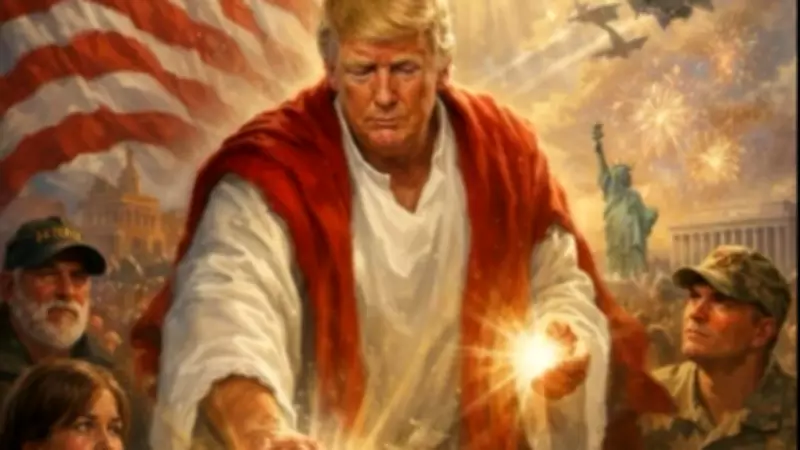
Former US President Donald Trump addressed the controversy on Monday surrounding his now-deleted social media post featuring an AI-generated image that portrayed him in a manner reminiscent of Jesus Christ. The image, which sparked fierce backlash from his own prominent Christian supporters, was posted on Sunday night and removed by late Monday morning.
Trump's Explanation and Defense
In response to the uproar, Trump offered a defense of the post, stating, "I did post it, and I thought it was me as a doctor and it had to do with the Red Cross." He elaborated, "It's supposed to be me as a doctor, making people better. And I do make people better. A lot better." Trump dismissed the widespread criticism as "fake news," maintaining that the image was intended to show him in a healing role rather than drawing a direct comparison to religious figures.
Content of the Controversial Image
The AI-generated image depicted Trump wearing a biblical-style robe, with his hands placed over a bedridden man as light appeared to radiate from his fingers. The scene included several onlookers: a soldier, a nurse, a praying woman, and a bearded man in a baseball cap, all gazing admiringly at Trump. The background featured eagles, an American flag, and vapor-like religious imagery in the sky. Notably, in Trump's version, a silhouetted US soldier from the original image was altered to appear as a horned, demon-like presence looming behind him.

Backlash from Christian Supporters and Conservatives
The post triggered significant backlash from a broad spectrum of commentators, including some of Trump's evangelical supporters who objected to the imagery suggesting a comparison with Christ. This represented a rare break within Trump's usual base of support.
Riley Gaines, a Fox News host and conservative commentator, expressed strong disapproval on social media platform X. She wrote, "I cannot understand why he'd post this. Is he looking for a response? Does he actually think this? Either way, two things are true. 1) a little humility would serve him well 2) God shall not be mocked." Gaines further questioned, "I don't know if the President thought he was being funny or if he is under the influence of some substance or what possible explanation he could have for this," and demanded that Trump "take this down immediately and ask for forgiveness from the American people and then from God."
Isabel Brown also condemned the image, calling it "disgusting and unacceptable." She emphasized, "Nothing matters more than Jesus. This post is, frankly, disgusting and unacceptable, but also a profound misreading of the American people experiencing a true and beautiful revival of faith in Christ."
Steve Deace of BlazeTV reacted more tersely, posting a single-word response: "No."
International and Political Reactions
The controversy extended beyond US borders, with Iran's President Masoud Pezeshkian condemning the post as a "desecration of Jesus," while simultaneously defending the Pope in his remarks.
Amid the criticism, US Vice President JD Vance came to Trump's defense, suggesting the president meant it as a "joke." Vance stated, "I think Trump was posting a joke and, of course, he took it down because he recognized that a lot of people weren't understanding his humor in that case."
Origin and Deletion of the Image
The image first appeared in early February on X, where it was posted by conservative commentator Nick Adams, who is known for sharing AI-generated pro-Trump biblical-style visuals. In Adams's original version, a silhouetted US soldier was visible in the background. Trump's modified version replaced this figure with the demon-like presence.
The image was deleted from Trump's account late Monday morning, following the intense backlash and criticism from various quarters. The incident highlights the ongoing tensions between political imagery, religious sensitivity, and the use of AI-generated content in modern political communication.