TMC Accuses BJP-Led Centre of Policing Food Habits Over Vande Bharat Sleeper Train Menu
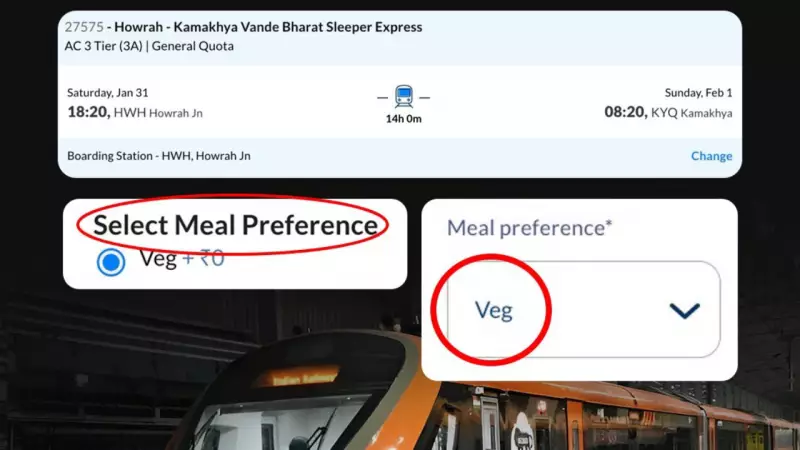
West Bengal's ruling Trinamool Congress (TMC) has launched a sharp criticism against the BJP-led Central government and Prime Minister Narendra Modi, alleging an attempt to impose uniform food habits across India. The controversy erupted after the newly launched Vande Bharat sleeper train between Kolkata and Kamakhya offered exclusively vegetarian food options, despite connecting regions where fish and meat are dietary staples.
"First They Policed Our Votes, Now They're Policing Our Plates"
In a strongly worded post on social media platform X, the TMC declared: "First they policed our votes. Now they're policing our plates." The party pointed out that while Prime Minister Modi recently highlighted the introduction of the new Vande Bharat sleeper service for Bengal during its flag-off ceremony, he conspicuously omitted mentioning the significant changes to the train's food offerings.
"Just days ago, PM Modi was busy boasting about giving Bengal a new Vande Bharat sleeper train. What he didn't mention however is that on the Vande Bharat train running from Bengal to Assam, fish and meat have been taken off the menu," the TMC stated in their social media post.

Cultural Significance of Non-Vegetarian Food in Eastern India
The TMC emphasized the deep cultural and culinary significance of non-vegetarian food in both West Bengal and Assam, regions known for their rich fish and meat-based cuisines. "A train connecting two regions where people cherish non-vegetarian food now offers only vegetarian options," the party noted, describing this move as part of what they termed a larger ideological pattern.
The party characterized this development as "the natural extension of a mindset" that seeks to impose uniformity across India's diverse cultural landscape. In their criticism, the TMC referenced several previous incidents to bolster their argument:
- Alleged derogatory remarks about fish-eating Bengalis
- Restrictions on fish sales in certain parts of Delhi
- The assault of a street vendor for selling chicken patties
Broader Implications and Political Standoff
The TMC's statement took a broader view of the situation, warning: "Today it's what we eat. Tomorrow it's what we wear. Who we love. How we live." The party framed this as what they called the 'Banchte Chai, BJP Tai' model, where Bengalis are allegedly being pushed into submission by forces imposing monolithic, homogenized identities on the region's plural ethos.
Reiterating their firm opposition to what they described as cultural imposition, the TMC added: "Bengal will not take lessons on identity from those who neither understand nor respect it." This criticism comes just days after Prime Minister Modi officially flagged off India's first Vande Bharat sleeper train on January 17 from Malda town in West Bengal.
Technical Details and Public Response to Vande Bharat Sleeper
The semi-high-speed, fully air-conditioned Vande Bharat sleeper train is specifically designed for overnight travel and aims to significantly improve connectivity between eastern India and the Northeast region. According to the Ministry of Railways, the first commercial run of this train between Howrah and Kamakhya received an overwhelming public response.
All tickets for the inaugural journey sold out within hours of bookings opening, with reservations being fully booked within just 24 hours after ticket sales began on January 19. The train commenced its maiden commercial journey from Kamakhya on January 22 and from Howrah on January 23.
The Vande Bharat sleeper train will operate six days a week and is expected to complete the Howrah-Kamakhya journey in approximately 14 hours, making it the fastest service currently available on this route. Railway officials have noted that the strong demand reflects a growing public preference for modern trains that offer:
- Shorter travel times
- Enhanced safety features
- Improved passenger comfort
Train Specifications and Amenities
The Vande Bharat sleeper consists of 16 coaches with the following configuration:

- AC 3-tier compartments
- AC 2-tier compartments
- First AC compartments
The train has a total passenger capacity of 823 and is equipped with advanced safety systems along with upgraded passenger amenities designed to provide a comfortable travel experience. This development marks a significant step in India's railway modernization efforts, though it has now become entangled in political controversy over cultural and dietary preferences.