

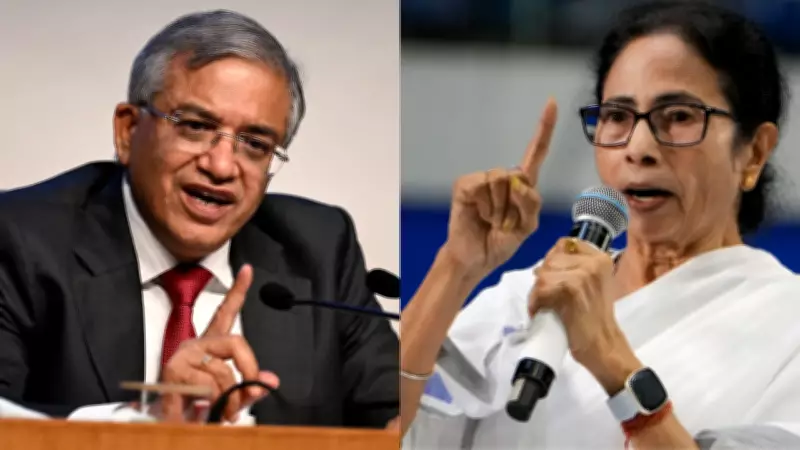
NEW DELHI: In a significant political development, Trinamool Congress (TMC) Member of Parliament Kalyan Banerjee declared on Tuesday that his party is actively considering the introduction of an impeachment motion against Chief Election Commissioner (CEC) Gyanesh Kumar. This potential action stems from serious concerns regarding the manner in which the Election Commission is executing the Special Intensive Revision (SIR) of electoral rolls in West Bengal and several other states.
TMC's Strong Stance on Electoral Process
Kalyan Banerjee, addressing reporters in the national capital, expressed profound dissatisfaction with the conduct of the SIR exercise. "We will bring an impeachment motion against the CEC," he asserted unequivocally. "The methodology they are employing for the Special Intensive Revision is fundamentally flawed and incorrect." The TMC parliamentarian elaborated that this approach could potentially undermine the voting rights of countless citizens across the nation.
Banerjee further emphasized, "This procedural anomaly appears designed to systematically disenfranchise voters. We perceive this as an ill-motivated initiative that threatens democratic principles. Consequently, we are seriously contemplating an impeachment motion to address this grave concern." He also revealed that the TMC is engaging in discussions with other political parties to build consensus and explore collaborative action on this critical issue.

Political Context and Party Position
The Trinamool Congress holds considerable political weight as the third-largest opposition party in the Lok Sabha, and the fourth-largest overall, with twenty-eight members representing West Bengal exclusively. The party has maintained governance in West Bengal since 2011, establishing a strong regional presence. This political standing provides significant impetus to their current confrontation with the Election Commission.
Mamata Banerjee's Confrontational Meeting
Kalyan Banerjee's statements followed a highly charged meeting between West Bengal Chief Minister and TMC supremo Mamata Banerjee and the Election Commission officials. The previous day, Mamata Banerjee met with CEC Gyanesh Kumar and two other election commissioners at the EC office in Delhi specifically to discuss the SIR controversy.
Reports indicate that the meeting concluded abruptly and dramatically, with the West Bengal Chief Minister reportedly slamming the table in frustration before storming out of the conference room. This visible display of discontent highlighted the escalating tensions between the state government and the central election body.
Press Conference with Alleged Victims
On Tuesday, Mamata Banerjee organized a press conference in Delhi, presenting individuals she described as "victims" of the SIR process from West Bengal. She claimed these individuals symbolically represented numerous others who have suffered due to the electoral revision exercise.
"The people seated behind me are all SIR victims," Mamata Banerjee stated during the conference. "I could have brought lakhs of affected people here to demonstrate the scale of this issue. The fundamental problem is that the authorities are not providing SIR victims with any genuine opportunity to defend themselves or present their cases properly."
Questioning the Timing and Selectivity
The West Bengal Chief Minister raised pointed questions about both the timing and the selective implementation of the Special Intensive Revision. She specifically challenged why this extensive exercise was being initiated just ahead of crucial assembly elections in several states.
Furthermore, Mamata Banerjee highlighted what she perceives as political bias in the process. "Why is the SIR being conducted exclusively in opposition-ruled states that are approaching elections, while BJP-ruled Assam is undergoing only a standard Special Revision (SR) of electoral rolls?" she questioned. This comparison suggests concerns about unequal treatment between states governed by different political parties.

"Among the four election-bound states, they are implementing SIR in three states but exempting BJP-ruled Assam," she clarified, referring specifically to West Bengal, Tamil Nadu, and Kerala. These three states, along with Assam and the Union Territory of Puducherry, are scheduled to hold assembly elections around April–May, making the electoral roll revision particularly sensitive.
Legal Challenges in the Supreme Court
Adding another layer to this controversy, the Supreme Court of India is currently hearing multiple petitions challenging the West Bengal SIR process. Notably, some of these petitions have been filed by TMC Members of Parliament, indicating a multi-pronged strategy combining political, public, and legal avenues to address their grievances with the electoral revision exercise.
The convergence of political statements, public demonstrations, and legal proceedings creates a complex scenario that underscores the deepening conflict between the Trinamool Congress and the Election Commission of India over electoral procedures ahead of significant state elections.





