

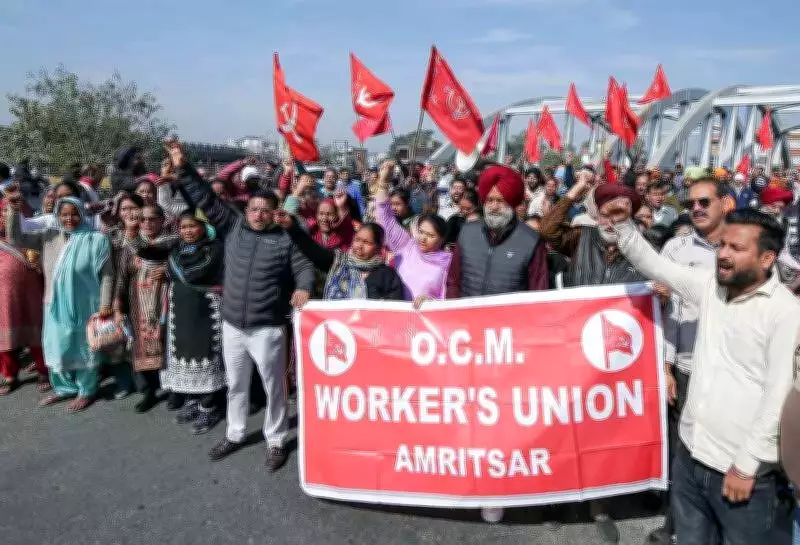
SKM Reports Unprecedented Farmer Participation in National Labor Code Protests
The Sanyukt Kisan Morcha (SKM) has declared that farmer participation and coordination in recent mass protest demonstrations were more widespread than ever before. These demonstrations were organized by the Joint Platform of Central Trade Unions, independent sectoral federations, and various other trade unions specifically to oppose the implementation of the four controversial labor codes.
National Council Meeting to Strategize Next Phase of Action
In a significant development, the SKM has announced that its National Council meeting, scheduled for February 24 in Kurukshetra, Haryana, will deliberate on a concrete and comprehensive plan for the next phase of independent action. Furthermore, the meeting will explore strategies for unified efforts with platforms and unions representing workers, agricultural laborers, and MGNREGA workers who are willing to join the ongoing struggles.
The primary objectives of these coordinated efforts are twofold:

- To ensure a complete reversal of corporate-friendly policies that are perceived as detrimental to farmers and workers.
- To exert substantial pressure on the government to accept the genuine and long-standing demands of farmers and other segments of the working population.
The SKM emphasized that the ultimate goal of this intensified agitation is to achieve either a significant policy change or a broader regime change, thereby addressing the core issues faced by the agricultural and labor communities.
Widespread Impact Across Multiple Sectors
The protest demonstrations had a tangible and disruptive impact across various states, affecting a wide array of critical sectors. Key industries that experienced notable disruptions include:
- Coal and electricity production and distribution.
- Insurance and banking services.
- Port operations and maritime activities.
- The entire manufacturing sector.
- Various services, with a particular emphasis on transport networks.
This widespread participation and sectoral impact underscore the deepening alliance between farmer groups and organized labor, marking a pivotal moment in the collective opposition to the government's labor code reforms.






