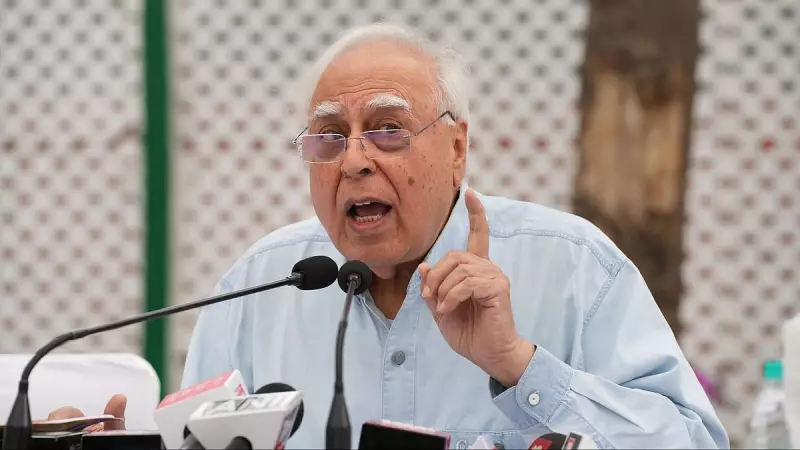
Senior advocate and Rajya Sabha MP Kapil Sibal has launched a sharp critique against the Enforcement Directorate (ED), stating that only the Supreme Court possesses the authority to rein in the central agency. His comments come in the wake of recent searches conducted by the ED at the offices of the Indian Political Action Committee (I-PAC), a political consultancy linked to the Trinamool Congress (TMC) in West Bengal.
The Context: ED Raids on Political Consultancy
The Enforcement Directorate carried out searches at multiple locations linked to I-PAC on a recent Tuesday. The action was part of an ongoing money laundering investigation. I-PAC, founded by political strategist Prashant Kishor, has been closely associated with Mamata Banerjee's Trinamool Congress, particularly during the 2021 West Bengal assembly elections.
While the ED's official stance links the raids to a specific money laundering probe, the move has ignited a fierce political debate. Opposition parties have consistently accused the central agency of being used as a tool by the ruling dispensation to target political rivals.

Kapil Sibal's Forceful Argument
In a strong statement, Kapil Sibal questioned the unchecked power of the ED. He argued that the agency's actions often seem to lack proper judicial oversight at the initial stages, allowing for potential misuse. Sibal emphasized that the current legal framework grants the ED significant authority to summon individuals and conduct searches, which can be intimidating.
"The problem is that the ED comes and picks you up. They don't require the permission of the court to arrest you. They don't require the permission of the court to summon you. They don't require the permission of the court to search your premises," Sibal was quoted as saying.
His central contention is that this vast power needs a balancing mechanism. He believes that only the Supreme Court of India can establish guidelines or rules to ensure these powers are not exercised arbitrarily. Sibal suggested that the apex court must step in to define the limits and procedures for such agencies to protect citizens' rights.
Political Repercussions and the Bigger Picture
The raids on I-PAC have further strained the already tense relations between the Trinamool Congress and the central government. TMC leaders have condemned the searches, labeling them as politically motivated harassment aimed at destabilizing the party in West Bengal.
This incident feeds into a larger narrative where multiple opposition-ruled states have witnessed ED actions against political leaders and their associates. The debate now extends beyond a single raid to encompass fundamental questions about:
- The autonomy and perceived impartiality of central investigative agencies.
- The need for robust safeguards against the potential weaponization of these agencies.
- The role of the judiciary in acting as a check on executive power.
Kapil Sibal's remarks underscore a growing demand from legal experts and opposition quarters for judicial intervention. The call is for the Supreme Court to lay down a clear framework that prevents investigative agencies from being used for political vendetta while still allowing them to function effectively against genuine corruption.
As the political temperature rises, all eyes are on whether this legal challenge will be formally taken up in the highest court, setting a potential precedent for the future of federal investigations in India.