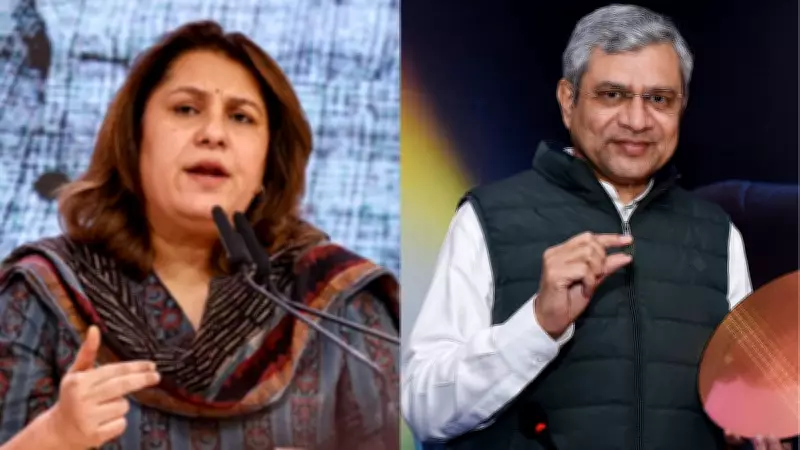
Congress Leader Supriya Shrinate Launches Scathing Attack on Ashwini Vaishnaw Over AI Investment Disparity
In a strongly worded critique, Congress spokesperson Supriya Shrinate has accused Union Minister for Electronics and Information Technology Ashwini Vaishnaw of what she terms "big names, small vision" regarding India's approach to Artificial Intelligence development. The political firestorm erupted as Shrinate highlighted what she describes as a massive funding gap between India and global leaders in AI technology.
Stark Contrast in AI Investment Figures
Shrinate presented compelling comparative data during her remarks, revealing that while the United States allocated a staggering 198 billion dollars toward Artificial Intelligence initiatives and research in the previous fiscal year, India's corresponding expenditure failed to reach even 1.9 billion dollars. This represents a funding ratio of approximately 100:1 between the two nations' AI investments.
"These numbers tell a story of missed opportunities and inadequate prioritization," Shrinate asserted. "When global superpowers are making hundred-billion-dollar commitments to secure their technological future, we're barely scratching the surface with investments that don't even cross the two-billion-dollar threshold."

Political Implications and Policy Critique
The Congress leader's comments come amid growing political debate about India's position in the global technology race. Shrinate specifically targeted Minister Vaishnaw, suggesting that despite holding prominent positions and making ambitious announcements, the actual financial commitment to transformative technologies like AI remains insufficient.
"We have ministers with impressive titles and frequent media appearances, but when it comes to substantive investment in technologies that will define the 21st century, the vision appears remarkably small," Shrinate remarked, directly referencing her "big names, small vision" criticism.
The controversy touches on several critical areas:
- Global Competitiveness: How India positions itself against technological powerhouses
- Economic Strategy: The role of AI in future economic growth and job creation
- Policy Implementation: The gap between political announcements and budgetary allocations
- National Security: The strategic importance of AI development
Broader Context of India's AI Ambitions
India has publicly expressed ambitions to become a significant player in Artificial Intelligence, with various government initiatives and policy frameworks announced in recent years. However, Shrinate's criticism suggests that financial backing hasn't matched rhetorical commitments.
The funding disparity highlighted by the Congress leader raises important questions about resource allocation in a country balancing multiple development priorities. While the United States' 198-billion-dollar AI investment represents a massive concentrated effort, India's sub-2-billion-dollar expenditure must be contextualized within broader budgetary constraints and competing needs.
Nevertheless, Shrinate maintains that the gap is too substantial to ignore. "In the race for technological supremacy, incremental investments won't suffice," she argued. "Either we commit seriously to AI development with appropriate funding, or we risk becoming permanently dependent on foreign technology in a domain that will shape everything from healthcare to national security."
The political exchange underscores growing tensions between the ruling establishment and opposition parties regarding technology policy and implementation. As Artificial Intelligence continues to transform global economies and societies, debates about appropriate investment levels and strategic priorities are likely to intensify in India's political landscape.