

Seer Advocates for Government Action to Alleviate Farmer Hardships
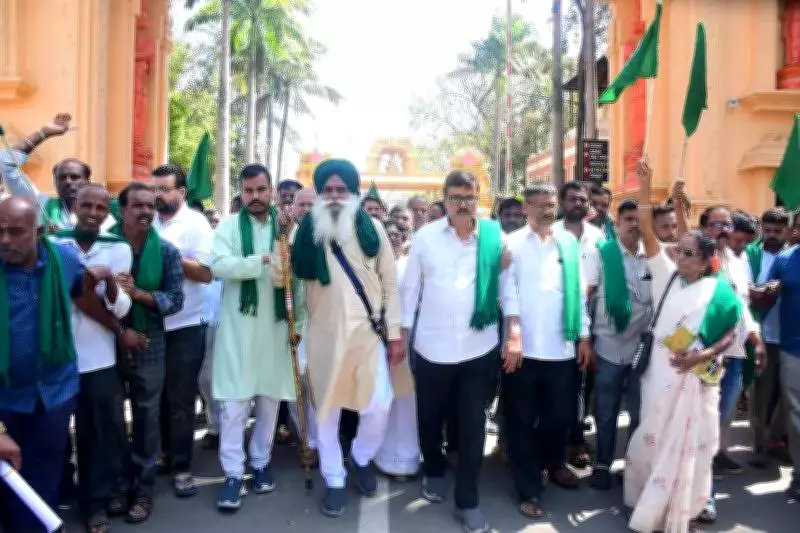
Mysuru: Avadhoota Datta Peetham seer Ganapathi Sachchidananda Swami on Wednesday made a strong appeal to governments at all levels, urging them to pay special and immediate attention to alleviating the hardships faced by farmers across the nation. The spiritual leader delivered this message while addressing participants of a significant farmers' awareness march that had arrived in Mysuru via Chamarajanagar earlier that day.
Farmers' Awareness March Gains Momentum
The march, organized in collaboration with the Samyukta Kisan Morcha and various state farmer organizations, represents a crucial segment of a larger movement traveling from Kanyakumari to Kashmir. Welcoming the marchers at the Avadhoota Datta Peetham, Swami Ganapathi Sachchidananda emphasized the indispensable role of farmers in national sustenance and security.
The seer articulated that farmers constitute the very backbone of the nation, providing the essential food resources that enable soldiers to safeguard the country's borders and citizens to thrive. He stressed that this fundamental contribution necessitates that governments prioritize and actively address the myriad agricultural issues plaguing the sector, from economic distress to policy shortcomings.

Historical Context and Current Grievances Highlighted
In his introductory remarks, national co-coordinator Kuruburu Shanthakumar detailed the core objectives driving the march. He drew a poignant parallel with India's colonial history, suggesting that just as British trade engagements eventually led to political domination, contemporary international agreements, particularly those with the United States negotiated by current authorities, are proving severely detrimental to Indian farmers' interests and livelihoods.
Shanthakumar provided a detailed account of unfulfilled promises and governmental inaction. He recalled that during the extensive year-long farmers' movement at the Delhi borders, Union Minister Piyush Goyal conducted five meetings, each lasting approximately five hours, where he pledged support for five key agricultural products. However, no substantive action or policy implementation followed these assurances, leaving farmers disillusioned.
Furthermore, when another protest was launched subsequently, the Supreme Court intervened by forming a special committee. This committee reportedly submitted a farmer-friendly report, yet no decisive action or legislative change was undertaken based on its recommendations. Shanthakumar also highlighted that a 31-member parliamentary committee had formally recommended the enactment of a Minimum Support Price (MSP) guarantee law, a critical demand of farming communities, but this proposal similarly saw no legislative progress.
Unimplemented Reports and Disappointing Responses
A particularly significant point of contention raised was the Swaminathan Commission report. Submitted in 2007 during Prime Minister Manmohan Singh's tenure, the report's recommendations were promised implementation by Prime Minister Narendra Modi in 2014. However, the Central government later informed the Supreme Court that implementing these recommendations was not feasible, a stance described by Shanthakumar as profoundly disappointing for the agricultural community.
He contrasted historical and contemporary governmental responsiveness, noting that during British rule, when farmers signaled impending protests, the colonial administration often acted swiftly to resolve issues. In stark contrast, he asserted that today's governments frequently demonstrate indifference and delay, exacerbating farmers' struggles.
Call to Action and Future Plans
In response to this perceived governmental apathy, Shanthakumar issued a clarion call, stating, "Farmers must stand united against this neglect." He announced plans for a massive gathering scheduled for March 19 at Delhi's iconic Ramlila Maidan, intended to amplify their demands on a national stage.

The ongoing 40-day nationwide march serves a dual purpose: to collect signatures from farmers across the country and to compile a comprehensive representation to be submitted directly to the Prime Minister. The core appeal urges the Prime Minister to come to Delhi and engage directly with farmer leaders to address their long-standing concerns regarding agricultural policy, economic support, and livelihood security.
Widespread Participation in the Movement
The march has seen robust participation from farming communities across multiple states. Hundreds of farmers, including prominent leaders from Haryana, Uttar Pradesh, Rajasthan, Madhya Pradesh, and Punjab, joined the procession as it made its way through Mysuru, demonstrating the widespread and pan-Indian nature of the grievances and the solidarity within the agricultural sector.





