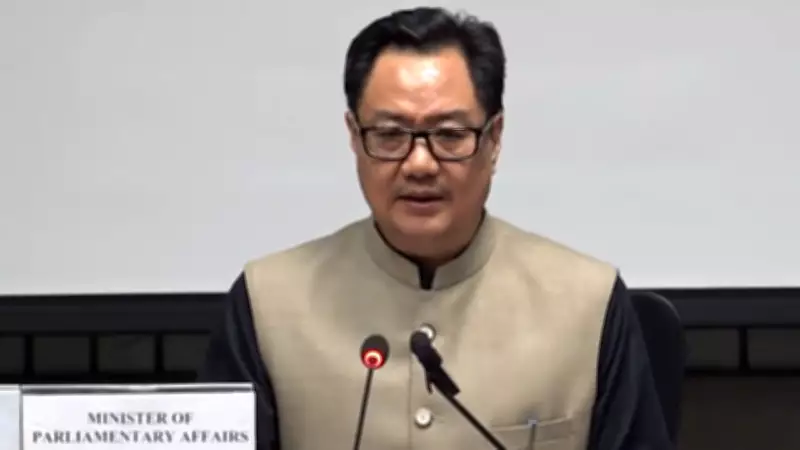
Rijiju Accuses Congress of Causing Major Setback to Women's Reservation Bill
Union Parliamentary Affairs Minister Kiren Rijiju stated on Saturday that the defeat of the women's reservation bill in the Lok Sabha should not be interpreted as a failure of the government. Instead, he squarely blamed the Congress party for causing what he described as a significant setback to the country's progress toward gender equality in political representation.
Budget Session Extension and Failed Constitutional Amendment
Addressing a press conference following the conclusion of the extended Budget session, Rijiju explained that the session had been prolonged for three additional days—April 16, 17, and 18—specifically to introduce the Nari Shakti Vandan Adhiniyam and the Delimitation Bill. "We have the majority, but we didn't get the two-thirds majority needed for a Constitution Amendment," Rijiju clarified, referring to the government's numerical strength in the house.
The minister emphasized that despite the government's majority, the bill proposing women's reservation through a delimitation exercise failed to secure the required two-thirds support. Official voting records showed 298 members in favor and 230 opposing the legislation, falling short of the constitutional threshold.

Political Consequences and Opposition Criticism
Rijiju issued a stern warning to the opposition, particularly targeting the Congress party. "Congress will have to face the anger of women; celebrating women's defeat is proof of their anti-women mindset," he declared. The minister asserted that the opposition would bear the brunt of what he characterized as an anti-women position during future electoral contests.
Following the vote outcome, Lok Sabha Speaker Om Birla officially announced that the Constitution Amendment Bill had not been passed. In response, Rijiju confirmed that the government would not proceed with the remaining two interlinked bills that were part of the legislative package.
BJP's Allegations and Opposition's Defense
The Bharatiya Janata Party has consistently accused opposition parties of obstructing what they describe as a historic reform aimed at ensuring 33 percent reservation for women in both Parliament and state assemblies. Union Home Minister Amit Shah reinforced this position, alleging that parties including Congress and the Trinamool Congress had deliberately prevented the bill's passage and warning of inevitable political repercussions.
However, opposition leaders have maintained a different perspective on the matter. They argue that while they fundamentally support women's reservation in principle, they oppose linking it to delimitation and census processes. Leader of the Opposition in the Lok Sabha, Rahul Gandhi, characterized the bill as an attempt to fundamentally alter India's electoral structure. Several Congress leaders further described their vote against the legislation as a defense of democratic values and procedural integrity.
The political debate surrounding the women's reservation bill has thus evolved into a complex confrontation between the government's push for gender-based political quotas and opposition concerns about the legislative mechanisms through which such reservation would be implemented. Both sides now prepare for the political fallout as they position themselves on what has become a highly charged issue of women's representation in Indian democracy.