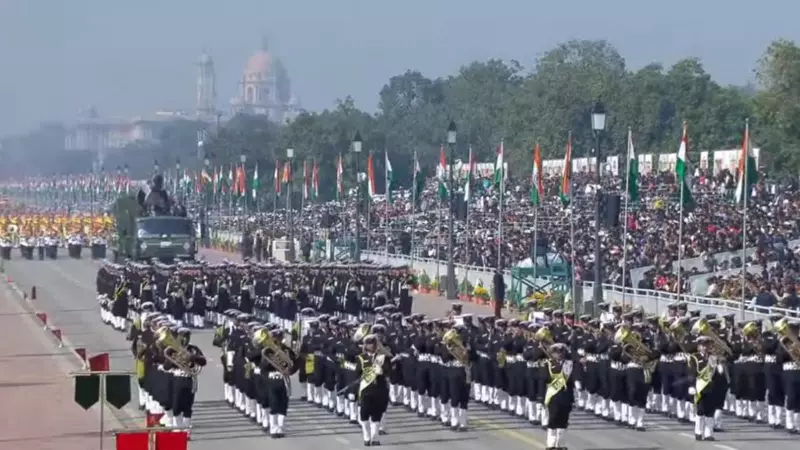
India's 77th Republic Day Parade Highlights Military Prowess and International Partnerships
India celebrated its 77th Republic Day with a grand parade that prominently showcased the nation's military capabilities, particularly focusing on achievements from Operation Sindoor. The event, held at Kartavya Path in New Delhi, marked the first Republic Day since the military operation, with the theme '150 years of Vande Mataram' resonating throughout the celebrations.
Distinguished International Guests and Ceremonial Opening
President of the European Council Antonio Costa and President of the European Commission Ursula von der Leyen served as chief guests, representing a significant diplomatic moment. The parade commenced with President Droupadi Murmu arriving in a traditional buggy alongside the European dignitaries, taking the salute as the ceremonial proceedings began.
Prime Minister Narendra Modi, Defence Minister Rajnath Singh, numerous Union ministers, top military officials, foreign diplomats, and approximately 10,000 special guests witnessed the spectacular display of national pride and defense preparedness.

Comprehensive Military Display and Indigenous Weapon Systems
The parade featured an extensive array of indigenous weapon systems that demonstrated India's growing self-reliance in defense technology. Key displays included:
- BrahMos supersonic missiles
- Akash weapon systems
- 'Suryastra' universal rocket launcher system
- Main Battle Tank Arjun
- Dhanush artillery guns
- Divyastra battery systems
For the first time, the parade presented a phased Battle Array Format of the Indian Army, incorporating both ground and aerial components to demonstrate integrated combat capabilities.
Aerial Dominance and Special Formations
The Indian Air Force contributed significantly to the celebrations with 29 aircraft participating in the flypast, including:
- 16 fighter jets featuring Rafale, MiG-29, Su-30, and Jaguar aircraft
- 4 transport aircraft
- 9 helicopters
Notably, two Rafale jets, two MiG-29s, two Su-30s, and one Jaguar aircraft flew in a special Op Sindoor formation, commemorating the military operation's success. The IAF ground contingent comprised four officers and 144 airmen, adding to the ceremonial grandeur.
Ground Forces and Advanced Technology Showcase
The ground parade featured multiple mechanized columns and specialized units, including:
- 61 Cavalry reconnaissance element
- High Mobility Reconnaissance Vehicle
- India's first indigenously designed Armoured Light Specialist Vehicle
- T-90 BHISHMA and Main Battle Tank Arjun with aerial support
- BMP-II Infantry Combat Vehicle with Nag Missile System (Tracked) Mk-2
Special Forces detachments displayed advanced tactical vehicles, while robotic dogs, Unmanned Ground Vehicles (UGVs), and four Autonomous Unmanned Ground Vehicles demonstrated cutting-edge military technology.
Innovative Combat Support and Surveillance Systems
The combat support element highlighted India's new generation unmanned warhead arsenal through Shaktibaan and Divyastra systems mounted on specialized High Mobility Vehicles. Advanced surveillance capabilities were demonstrated through:
- Swarm drones
- Tethered drone systems
- Indigenously developed tactical hybrid UAV ZOLT for artillery fire direction
- Various loitering munitions
A glass-cased Integrated Operational Centre provided a brief depiction of Operation Sindoor's conduct, rolling down Kartavya Path as a symbolic representation of the military operation's planning and execution.
Unique Animal Contingent and International Participation
The parade featured a distinctive animal contingent with soldiers accompanied by Bactrian camels, Zanskar ponies, black kites (raptors), indigenous vigilant birds, and Indian breed dogs including Mudhol Hound, Rampur Hound, Chippiparai, Kombai, and Rajapalayam. These animals were equipped with bullet-resistant jackets, cameras, GPS, radios, and advanced surveillance systems, showcasing their role in military operations.

Historically significant was the participation of a military contingent from the European Union, carrying the military staff flag and flags of Operations Atalanta and Aspides. This marked the EU's first participation in such an event outside of Europe, symbolizing strengthened international defense cooperation.
Naval Representation and Cultural Elements
The Indian Navy tableau depicted a stitched ship from the fifth century CE, now christened INSV Kaundinya, connecting historical maritime heritage with contemporary naval capabilities. The overall celebrations blended military demonstrations with cultural elements, creating a comprehensive display of national strength and tradition.
The 77th Republic Day parade successfully combined military might demonstration with diplomatic engagement, technological innovation display, and cultural heritage celebration, all under the unifying theme of '150 years of Vande Mataram'.