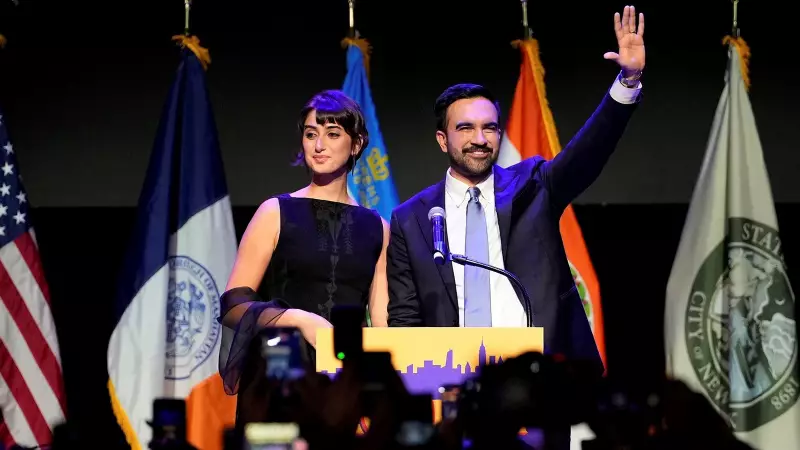
In the whirlwind of modern politics, where every move is scrutinised, the absence of New York City Mayor Zohran Mamdani's wife, Rama Duwaji, from the public glare has become a statement in itself. While Mamdani, a Democratic Socialist leader known for his rap campaigns and Gen Z appeal, captured headlines and even visited the White House, Duwaji has consciously stepped away from the ceremonial frame. This deliberate choice is reshaping conversations about the role and labour expected of political spouses.
The Art of Refusal: Duwaji's Deliberate Distance
Rama Duwaji, a professional animator, illustrator, and ceramist, has meticulously curated her public persona around her art and activism. Her Instagram presence steadfastly showcases Rama Duwaji the artist, with no overt indication of her marriage to one of America's most watched young mayors. This is not mere shyness; it is a conscious refusal to perform the part of the Gen Z First Lady. Experts note that her stance fits within a broader spectrum where political wives negotiate their visibility. They often engage in emotional, narrative, or reputational labour—sometimes by dodging, distracting, or disappearing—to indirectly shape the narrative of power.
This calculated distance becomes particularly significant against the backdrop of what is often termed the second shift for political partners: the unpaid, invisible work of support and representation. By drawing a firm boundary between her artistic identity and her husband's political project, Duwaji's silence itself becomes a potent critique of these manufactured expectations.

A Global Spectrum: From Hyper-Visibility to Curated Silence
Duwaji's approach stands in stark contrast to other prominent political spouses worldwide, each navigating visibility in their own way.
At one extreme is Brigitte Macron, wife of French President Emmanuel Macron, whose hyper-visibility defines her role. Despite strictly following a First Lady playbook, she has faced intense public scrutiny, notably over the couple's age gap. In 2021, the Macrons even confronted bizarre claims about Brigitte's gender, with their lawyer dismissing it as a distraction for the President. This episode highlights how, even when adhering to the script, a political wife's identity can be reduced to a mere sideshow to her husband's career.
Then there is the model of Melania Trump, former US First Lady, who perfected a brand of curated silence. Her communication was often through absence or fashion, like the infamous I REALLY DON'T CARE, DO U? jacket in 2018. Her perceived detachment raises questions: is such silence a strategic choice, a form of aloof control, or is her voice lost entirely within the political machinery?
The spectrum turns darker with figures like Asma al-Assad, wife of Syrian President Bashar al-Assad. Initially portrayed as a Rose in the Desert by Western media, her image later transformed into that of the First Lady of Hell. Her silence during the civil war, despite an offer of safe passage from the UK, was seen as weaponised, aestheticising an authoritarian regime.
Privilege, Labour, and the Indian Context
The discussion also touches figures born into privilege, like Akshata Murty, wife of UK Prime Minister Rishi Sunak. For Murty, an heiress and fashion designer, there was minimal sacrificial labour in supporting her husband's rise; she remained the main character in her own lucrative narrative. Her public celebration of Diwali at Downing Street, juxtaposed with her husband leading a party with anti-immigration sentiments, sparks debate on whether this reflects a life of privilege or symbolizes the aspirations of the Indian upper-middle class.
Perhaps the most vocal articulation of this spouse's labour came from Michelle Obama. In her memoir Becoming, she explicitly detailed the exhausting blend of emotional, racial, and reputational labour required to live under the microscope. Michelle Obama demonstrated that mere presence in the role is itself a form of intense, often invisible, work.

Against this global backdrop of gendered labour, Rama Duwaji's refusal to play by the book is not just a personal choice but a fascinating political act. By simply stepping out of the expected narrative, she challenges the very template. Her story, along with those of Macron, Trump, al-Assad, Murty, and Obama, illustrates the diverse, often fraught, ways women married to power negotiate their identity and agency. Published on December 6, 2025, this analysis by Namrata Roy and Soham Mukherjee invites a deeper look at the unwritten job description of a political partner.