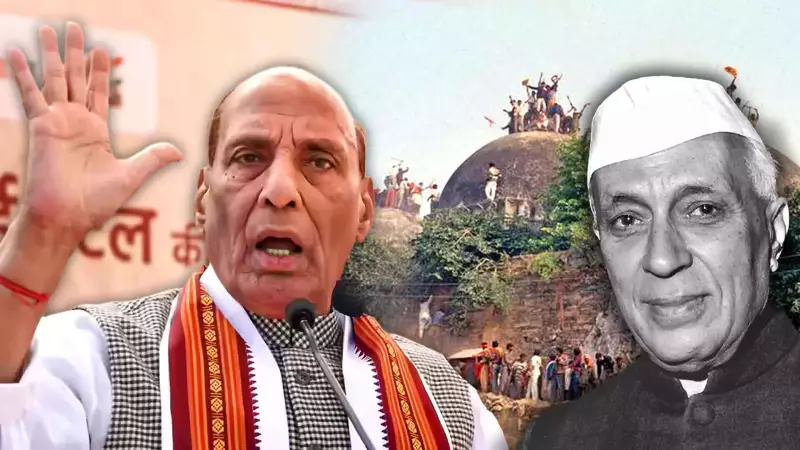
In a speech that has ignited a fierce political and historical debate across the nation, Defence Minister Rajnath Singh made a series of explosive allegations against India's first Prime Minister, Jawaharlal Nehru. Speaking during the Unity March from Karamsad to the Statue of Unity on December 3, 2025, Singh claimed that Nehru had intended to use public funds to construct the Babri Masjid, but was prevented by Sardar Vallabhbhai Patel.
The Core Allegation: A Clash of Ideologies
Rajnath Singh's address painted a stark contrast between the two towering figures of India's independence movement. He positioned Sardar Patel as the true liberal nationalist who stood firmly against any policy of appeasement. According to Singh, Patel's vision was clear: religious projects should be funded by the people's devotion, not the state's treasury. The Defence Minister cited the reconstruction of the Somnath temple and the recent Ram Temple in Ayodhya as embodiments of this Patel-esque principle.
In contrast, he accused Jawaharlal Nehru of deviating from this path. Singh alleged that Nehru not only wanted to use government money for the Babri Masjid but also actively worked to suppress Sardar Patel's legacy after his death. The Defence Minister went further, claiming that Nehru diverted public donations collected for a memorial dedicated to Patel and even awarded himself the Bharat Ratna while overlooking the Iron Man of India.

Linking Legacy to Modern Governance
Singh's speech was not merely a historical critique; it was a deliberate effort to draw a direct line from Sardar Patel's decisive leadership to the current government's actions. He connected Patel's tough, integrationist stance—from the forceful integration of Hyderabad to his firm position on Kashmir—with the governance style of Prime Minister Narendra Modi.
The Defence Minister presented contemporary policies as a continuation of Patel's vision. He specifically referenced Operation Sindoor and the abrogation of Article 370 as modern-day manifestations of the same resolute, nation-first approach that Patel championed. This framing aims to legitimize current political actions by rooting them in the legacy of a widely respected founding father.
Political Fallout and Historical Debate
The remarks have predictably triggered a massive controversy. Opposition parties and historians have challenged the claims, calling them a selective and politicized reading of history designed to serve a contemporary narrative. Supporters of the government, however, have hailed the speech for "setting the historical record straight" and highlighting what they see as Nehru's compromises.
The debate now centers on several key questions:
- The veracity of the specific claim about Babri Masjid's funding.
- The interpretation of Nehru's and Patel's complex relationship and differing philosophies.
- The use of historical figures in modern political discourse.
Rajnath Singh's address at the Statue of Unity, a monument dedicated to Sardar Patel, has ensured that this discussion will dominate India's political landscape for the foreseeable future, reopening old chapters of history to fight new political battles.