Rahul Gandhi Slams Modi Government Over Rupee's Record Low and Inflation Fears
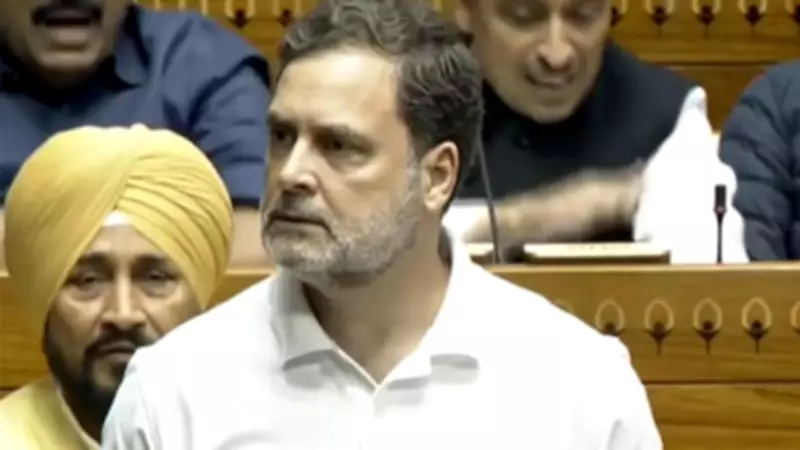
Leader of Opposition in Lok Sabha Rahul Gandhi has launched a scathing attack on the BJP-led central government, citing the falling rupee and rising industrial fuel prices as "clear signs" of impending inflation. He criticized the administration's "empty rhetoric" as India grapples with economic constraints exacerbated by an LPG shortage amid the escalating West Asia crisis.
Rupee Plunge and Economic Warnings
The Indian rupee plummeted to a historic low of 93.71 against the US dollar on Friday, marking a steep decline of 108 paise from its previous close of 92.63. This represents the currency's sharpest single-day fall in four years, driven by mounting concerns over sustained high oil prices above $100 per barrel. The widening conflict in West Asia, which increasingly targets critical energy infrastructure, has intensified these economic pressures.
In a post on social media platform X, Rahul Gandhi articulated his concerns: "The rupee weakening against the dollar and heading towards 100, coupled with a sharp rise in industrial fuel prices—these aren’t just numbers; they’re clear signs of the inflation to come." He dismissed government claims of normality, emphasizing the real-world impact on production, transport, and micro, small, and medium enterprises (MSMEs).

Direct Impact on Households and Post-Election Price Hikes
Gandhi warned that the economic strain would have a direct and profound impact on every family's finances. He predicted that prices for petrol, diesel, and LPG would be increased after the conclusion of state elections, accusing the Modi government of lacking direction and strategy. "The question isn’t what the government is saying—it’s what’s left on your plate," he remarked, highlighting the disparity between official statements and ground realities.
He elaborated on the cascading effects: "Production and transport will get more expensive; MSMEs will be hit the hardest; the prices of everyday items will go up; foreign institutional investor (FII) money will flow out even faster, putting more pressure on the share market." This outlook underscores the broader economic vulnerabilities exposed by the rupee's depreciation and global energy market volatility.
Kapil Sibal Echoes Concerns Over Energy Dependence
Rajya Sabha MP Kapil Sibal reinforced these apprehensions, pointing to India's heavy reliance on energy imports from the West Asia region. He argued that Iran's retaliatory actions could devastate the Indian economy due to dependencies on gas, LPG, and crude oil from the area. "The whole argument that is sought to be made is that we are reliant on the US for our trade… But no trade can perish, and no manufacturing can take place in the country without energy," Sibal stated.
He emphasized the strategic importance of the Strait of Hormuz for energy supplies and warned of long-term resource depletion. "Iran's retaliation for petroleum and gas resources in the Gulf will ultimately destroy our economy because we are dependent on gas, LPG, and crude oil from there, and it will take years to restore these resources," he added, urging the government to break its silence on the issue.
Broader Context of West Asia Crisis
The economic warnings come against the backdrop of heightened tensions in West Asia, including military actions and diplomatic maneuvers involving Israel, Iran, and the United States. Recent developments, such as Israel's strikes on Tehran during Nowruz celebrations and defensive responses from UAE and Kuwait, have further destabilized the region. Former US President Donald Trump's comments ruling out a ceasefire and signaling expanded military options add to the uncertainty, while Iran's claims of victory over the US and Israel complicate the geopolitical landscape.
These factors collectively threaten to prolong high oil prices and disrupt global energy flows, directly impacting India's import costs and economic stability. The combination of a weakening rupee, rising fuel prices, and external geopolitical risks presents a formidable challenge for policymakers and households alike.