

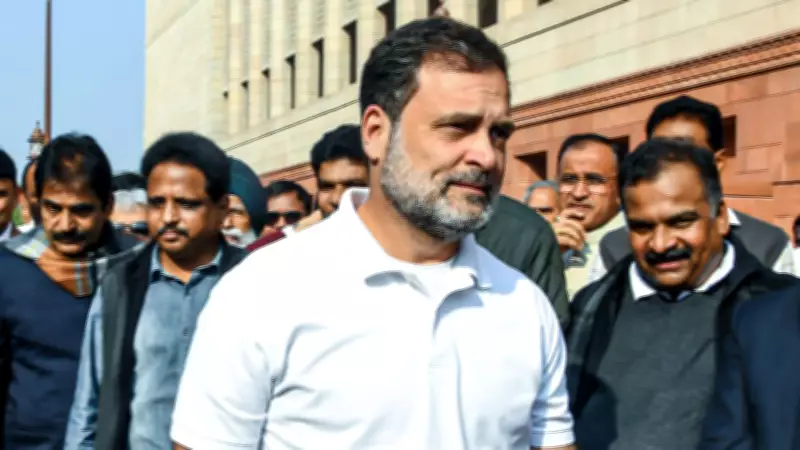
Rahul Gandhi Accuses Speaker of Undermining Opposition's Voice on National Security
In a significant development that has intensified parliamentary tensions, Congress leader and Leader of Opposition in Lok Sabha Rahul Gandhi has formally accused Speaker Om Birla of preventing him from addressing crucial matters of national security within the parliamentary framework.
Written Protest Over Parliamentary Proceedings
The controversy emerged following two days of parliamentary disruption centered around Rahul Gandhi's references to China in the unpublished memoirs of former Army Chief General MM Naravane. In response to what he perceives as systematic silencing, Gandhi has submitted a strongly worded letter to the Speaker, marking a formal protest against the treatment of opposition voices in the Lower House.
The Congress leader's communication to Speaker Om Birla explicitly states, "Preventing me from speaking in the Lok Sabha today not only violates this convention, but also gives rise to a serious concern that there is a deliberate attempt to prevent me, in my capacity as the Leader of the Opposition, from speaking on matters of national security."

Constitutional Responsibilities and Democratic Rights
Gandhi's letter emphasizes the constitutional obligations of the Speaker's office, noting that "as the impartial custodian of the House, it is your Constitutional and Parliamentary responsibility to safeguard the rights of every Member, including those of the Opposition." The communication further argues that "the right of the Leader of the Opposition and of each Member to speak is integral to our democracy."
The Congress leader specifically highlighted that national security constituted a significant portion of the President's Address to Parliament, which traditionally requires thorough discussion and debate among members. By restricting his ability to contribute to this discussion, Gandhi contends that fundamental democratic processes are being undermined.
Unprecedented Parliamentary Situation
In what Gandhi describes as an extraordinary development in India's parliamentary history, his letter states, "For the first time in Parliamentary history, on the behest of the government, the Speaker has been forced to prevent the Leader of the Opposition from speaking on the President's Address."
The Congress leader characterized this development as "a blot on our democracy" against which he has registered his strongest possible protest. This confrontation occurs during the ongoing Budget Session in New Delhi, where parliamentary decorum has been repeatedly tested by heated exchanges between treasury and opposition benches.
The situation raises important questions about:
- The balance between parliamentary discipline and opposition rights
- The Speaker's role in maintaining impartiality while managing house proceedings
- The appropriate boundaries for discussing sensitive national security matters in Parliament
- The historical precedent of opposition leaders' participation in presidential address debates
This development represents a significant escalation in the ongoing tensions between the ruling establishment and opposition parties regarding parliamentary procedures and the space for dissent in democratic institutions.






