

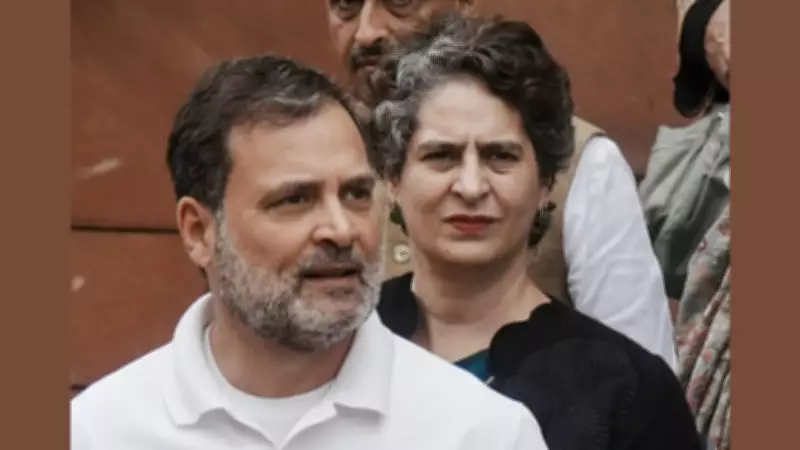
Congress MP Priyanka Gandhi Vadra on Monday strongly defended her brother and Lok Sabha Leader of Opposition Rahul Gandhi, asserting that his controversial remarks in Parliament were not intended to defame the Indian Army but were instead direct quotations from a magazine article referencing excerpts from the unpublished memoir of former Army Chief General MM Naravane.
Defending Parliamentary Remarks
Speaking exclusively to news agency ANI, Priyanka Gandhi Vadra clarified the context of Rahul Gandhi's statements. "He was not trying to defame the Army. He was reading an excerpt from the book of the Army Chief," she emphasized. The Congress leader further criticized the ruling party's response pattern, noting, "They [BJP] always say this whenever something comes out that they want to hide."
Parliamentary Disruptions and Adjournments
The Lok Sabha witnessed significant disruptions throughout the day, ultimately leading to multiple adjournments. The parliamentary standoff centered around Rahul Gandhi's insistence on discussing the 2020 India-China border tensions while referencing the report citing General Naravane's memoir. BJP members objected vehemently, arguing that Gandhi was speaking outside the established rules of the House.

During the discussion on the motion of thanks for the President's Address, Speaker Om Birla first adjourned proceedings until 3 pm, then extended the adjournment until 4 pm, before finally adjourning the House for the remainder of the day. The Speaker explicitly ruled that Gandhi should refrain from making references to the unpublished book or article, urging him to proceed without citing the controversial material.
Government's Strong Objections
Parliamentary Affairs Minister Kiren Rijiju launched a sharp criticism against Rahul Gandhi, accusing him of attempting to demoralize the armed forces. "Rahul Gandhi flouted rules and started quoting from a book whose publication and authenticity is not clearly mentioned," Rijiju stated. He questioned the Congress party's historical stance, asking, "Can the Congress party bring back the landmass that was captured by China in 1959 and 1962?"
The minister demanded an apology from Gandhi to the nation and challenged what he perceived as special treatment. "If someone is born in a known family, are they above the Parliament? Are they above the rules? India is a democratic nation and functions as per rules...Rahul Gandhi doesn't follow any rules," Rijiju asserted.
Defence Minister's Intervention
Defence Minister Rajnath Singh also urged the Chair to prevent Gandhi from making such references during parliamentary proceedings. Government sources, cited by news agency PTI, claimed that Gandhi was reading "concocted things" regarding China and pointed out that ample information about the India-China standoff during Jawaharlal Nehru's tenure already exists in the public domain.
Rahul Gandhi's Persistence on National Security
Despite repeated warnings from Speaker Birla, Rahul Gandhi remained steadfast in his determination to raise matters of national security. "It is uncomfortable for the defence minister and the prime minister, I understand. I consider national security the most important issue," Gandhi stated. He added, "If it was not uncomfortable, they would have let me speak, but the fact they are not allowing me to speak shows that they are uncomfortable."
Opposition Support for Gandhi
Several prominent opposition leaders rallied behind Rahul Gandhi's position, demonstrating cross-party support for his insistence on discussing the sensitive issue. Key supporters included:
- TMC's Mahua Moitra
- RJD's Manoj Jha
- SP chief Akhilesh Yadav
- Kalyan Banerjee
This show of opposition unity highlighted the political dimensions of the parliamentary confrontation, with multiple parties aligning behind the Congress leader's right to raise national security concerns despite government objections.
The day's events underscored the ongoing tensions between the government and opposition regarding parliamentary procedures, national security discussions, and the boundaries of acceptable debate concerning military matters and international relations.






