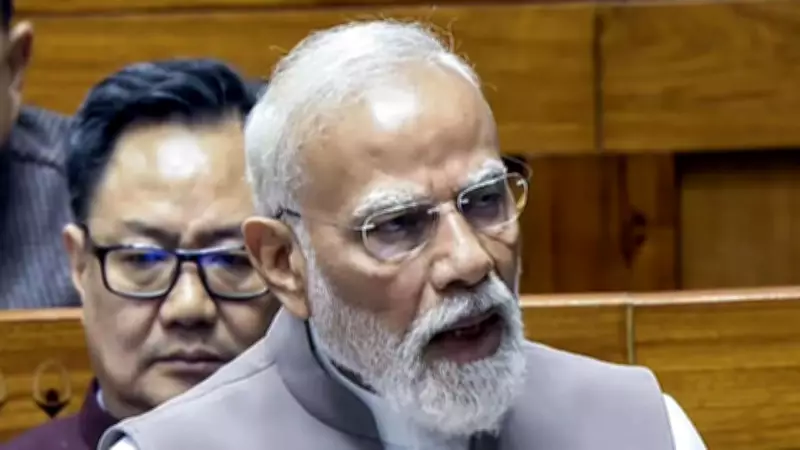
PM Modi Emphasizes India's Strategic Restraint in West Asia Conflict
Prime Minister Narendra Modi on Monday articulated his government's approach to the escalating crisis in West Asia, firmly stating that India's interests serve as the guiding principle in navigating the volatile situation. Speaking at a function organized by the TV9 Network, the Prime Minister underscored a commitment to peace and dialogue, directly addressing the ongoing tensions involving Israel, Iran, and the United States.
Prioritizing National Interests and Peace
"We are with India, with India's interests, with peace and with dialogue," declared PM Modi, framing India's posture as one of strategic restraint. His remarks are widely perceived as a response to persistent criticism from the Congress party, which has accused the government of not siding with Iran in its conflicts with the US and Israel.
The Prime Minister elaborated that this cautious and diversified diplomatic strategy has proven beneficial for India, especially as global supply chains face unprecedented strain. "India has presented a model of diversification and resilience, and ensuring that our citizens face the least possible difficulties has been our continuous endeavour," he asserted, highlighting efforts to mitigate the crisis's impact on development projects.

Criticism of Congress and Call for Unity
Modi chided the Congress for attempting to derive political mileage from the international turmoil, which has affected India economically and strategically. "This is a time for restraint and sensitivity; when countrymen unite to face a crisis, the results are always meaningful," he emphasized, urging national solidarity over partisan politics.
He contrasted his administration's proactive crisis management with the previous United Progressive Alliance (UPA) government's handling of similar challenges. Specifically, Modi pointed to the UPA's decision to issue oil bonds to companies during periods of rising crude prices, a move he described as being dictated by "remote control"—a veiled reference to the Nehru-Gandhi family.
Highlighting Economic Resilience and Policy Contrasts
The Prime Minister detailed how his government has shouldered the financial burden of past policies, noting that the oil bonds, with accrued interest, have cost over Rs 3 lakh crore. "It fell upon my government to pick up the tab for UPA's folly," Modi stated, referencing former Prime Minister Manmohan Singh's public unease about the bonds merely transferring burdens to future generations.
Modi also touted India's enhanced capabilities since 2014, asserting, "In these 23 days since February 28, India has demonstrated its relationship-building capacity, decision-making capacity and crisis management capacity." He credited the unity of 140 crore citizens for enabling the nation to overcome adversities, including those exacerbated by the Covid-19 pandemic, and expressed confidence in India's ongoing economic march.
Overall, PM Modi's address reinforced a foreign policy centered on national interest and strategic autonomy, while sharply criticizing opposition tactics and past governance failures in the context of global crises.