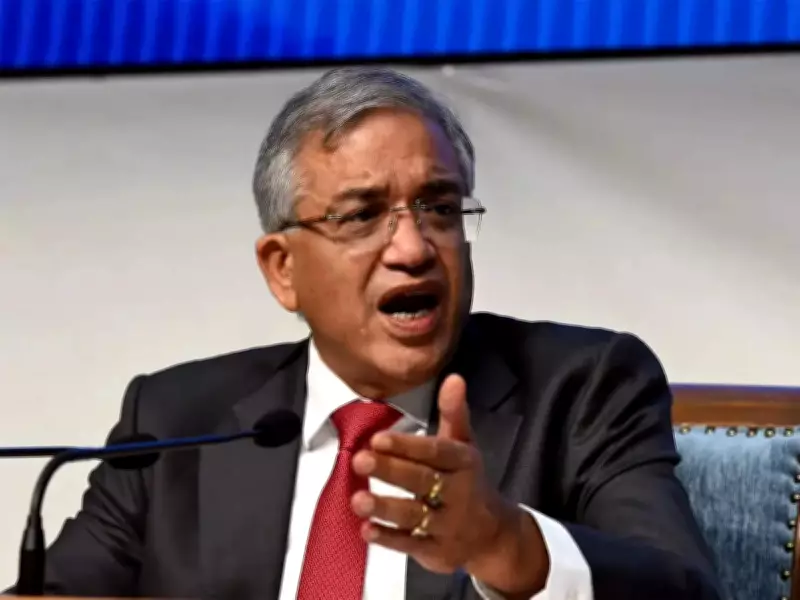
Opposition Launches Unprecedented Bid to Remove Chief Election Commissioner
In a dramatic political development, opposition parties on Friday submitted formal notices in both houses of Parliament seeking the removal of Chief Election Commissioner (CEC) Gyanesh Kumar. The move marks the first time such action has been taken against a sitting CEC and follows mounting allegations of partial conduct favoring a particular political party.
Multiple Charges Leveled Against Election Commissioner
The opposition has leveled six specific charges against Kumar, with the primary accusation being "partial conduct" in favor of an unnamed political party. According to parliamentary sources, the charges extend to Kumar's handling of electoral roll revisions, beginning with Bihar ahead of the November 2025 assembly elections and subsequently in other poll-bound states.
The notice explicitly accuses Kumar of "proved misbehaviour," a serious constitutional term that forms the legal basis for removal proceedings. Opposition parties have repeatedly alleged that Kumar, who joined the Election Commission in April 2024 and became CEC in February 2025, has systematically "aided" the ruling BJP on multiple occasions.

Broad Opposition Coalition Behind the Move
The removal notice was spearheaded by the Trinamool Congress (TMC), which governs West Bengal where assembly elections are scheduled for April-May 2026. The motion gained signatures from members of parties belonging to the INDIA bloc—the Congress-led national opposition alliance—along with MPs from the Aam Aadmi Party, despite its departure from the alliance.
A total of 193 parliamentarians signed the historic notice, comprising 130 Lok Sabha members and 63 Rajya Sabha members. This significantly exceeds the constitutional requirements of 100 Lok Sabha MPs and 50 Rajya Sabha MPs needed to initiate removal proceedings against a CEC.
Specific Concerns About Electoral Roll Manipulation
Central to the opposition's allegations are concerns about the ongoing Special Intensive Revision (SIR) of electoral rolls, which opposition parties claim could disproportionately benefit the ruling party at the Centre. Particular attention has focused on the SIR exercise in West Bengal, where TMC supremo and Chief Minister Mamata Banerjee has publicly accused the Election Commission of "deleting" genuine voters from electoral lists.
The opposition contends that Kumar's oversight of these revision processes demonstrates systematic bias that undermines the integrity of India's electoral system. These allegations come at a sensitive time with multiple state elections approaching and the next general election cycle drawing nearer.
Constitutional Process for CEC Removal
The removal process for a Chief Election Commissioner follows the same rigorous procedure established for removing Supreme Court or High Court judges, as outlined in Article 324(5) of the Constitution. Removal can only occur on grounds of proven misbehaviour or incapacity, requiring a complex parliamentary process.
- The motion must be introduced in either house of Parliament and passed by a special majority—a majority of the total membership of the house plus a two-thirds majority of members present and voting.
- Once admitted in both houses, a special committee will be jointly constituted by the Lok Sabha Speaker and Rajya Sabha Chairman.
- This committee will include the Chief Justice of India (or a Supreme Court judge), a High Court Chief Justice, and a distinguished jurist.
- The CEC will have the right to present his defense before this committee.
- Following the committee's report, parliamentary discussions will commence regarding potential impeachment.
- Final removal requires passage of the motion in both houses of Parliament.
This unprecedented constitutional confrontation highlights growing tensions between the opposition and election authorities ahead of crucial electoral contests. The outcome could have significant implications for India's democratic institutions and the perceived neutrality of its electoral oversight mechanisms.