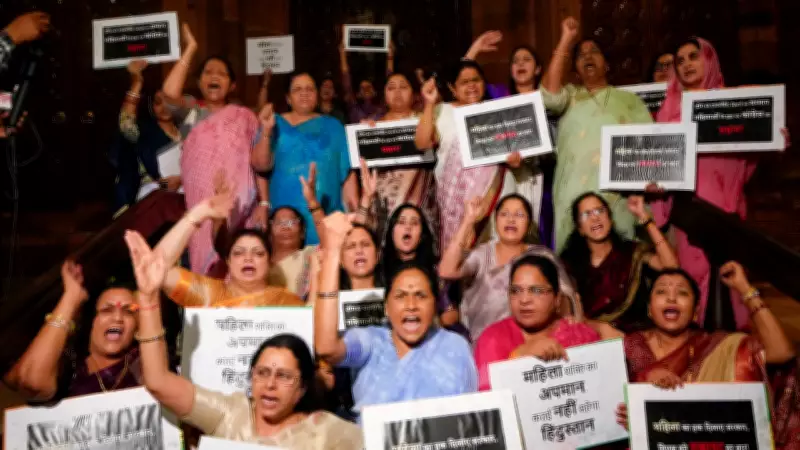
Modi Government Records First Parliamentary Defeat Since 2014
In a significant parliamentary development, Prime Minister Narendra Modi's National Democratic Alliance (NDA) government has encountered its first legislative failure since assuming power in 2014. This historic moment occurred on Friday when the government's Constitution Amendment Bill, which sought to implement 33% reservation for women in legislatures, failed to secure passage in Parliament.
A Strategic Defeat or Poor Planning?
From the outset, it was evident that the government would struggle to obtain the approximately 360 votes required for the bill's passage. Even with complete NDA support and potential backing from some undecided members, the numbers simply did not align. However, this apparent defeat may have been part of a calculated political strategy rather than mere legislative failure.
During the Lok Sabha debate, both Prime Minister Narendra Modi and Union Home Minister Amit Shah indicated that the government's intention extended beyond legislative success to encompass political positioning. By forcing a recorded vote, the government ensured that every Member of Parliament's stance would be documented, creating a powerful campaign tool in India's highly polarized political environment.

The Battle of Intent Versus Obstruction
BJP leaders framed this episode as a battle of "neeyat" or intent. Prime Minister Modi emphasized this during the debate, stating, "We don't want credit. I give you a blank cheque for claiming credit on passage of women quota bill. If you want me to use the word 'guarantee', I use the word 'guarantee'. If you want me to make a promise, I use the word 'promise'. Because if the intention is clear, there is no need to play games with words."
Even in defeat, the government positioned itself as having fulfilled its reformist duty while shifting the spotlight onto opposition parties that blocked the legislation. Parliamentary Affairs Minister Kiren Rijiju declared after the bill's defeat, "We will not take rest till we ensure that the country's women get reservation in legislatures."
The Delimitation Controversy
The bill's structure proved central to the controversy. Rather than being a standalone women's reservation measure, it formed part of a larger package linked to delimitation. The proposed amendment aimed to increase Lok Sabha strength from 543 to a maximum of 850 seats, with the 33% women's reservation tied to this expanded House, to be implemented after fresh delimitation based on updated population data.
Opposition parties including Congress, DMK, and Trinamool Congress argued that delimitation based on population would disproportionately affect southern states with slower population growth compared to northern regions. They accused the government of using women's reservation as cover for politically sensitive parliamentary restructuring.
Political Timing and Electoral Implications
The bill's timing carries significant political weight, with assembly elections scheduled in Tamil Nadu and West Bengal. The move allows BJP to shape political narratives well in advance of these crucial contests. Some analysts believe the bill would have relieved pressure to grant additional OBC quotas, given that "social justice" issues have become contentious for BJP's upper-caste social base.
Amit Shah explicitly warned during his parliamentary reply that those who voted against the bill would need to answer to women voters. Following the voting, Shah specifically blamed "Congress, TMC, DMK, and Samajwadi Party" for blocking the legislation, stating in a social media post, "The opposition will have to face the wrath of women not only in the 2029 Lok Sabha elections, but at every level, in every election, and at every place."
Alliance Mathematics Revealed
The vote provided valuable insights into current parliamentary alliance dynamics. While BJP's own Lok Sabha strength stands at 240, the NDA managed to secure 298 votes, indicating that coalition partners largely remained aligned. However, the government failed to attract sufficient opposition support or induce abstentions that could have lowered the effective majority threshold.

Regional parties including YSR Congress Party and Biju Janata Dal were closely monitored during the voting, making this exercise function as a litmus test of both strength and political reach.
The 2023 Law Safety Net
Even as the 2026 bill headed toward defeat, the government took procedural steps to ensure the broader objective of women's reservation remained intact. During the debate, authorities re-notified the 2023 Women's Reservation Act in the Gazette. This earlier legislation provides for 33% reservation in Lok Sabha and state assemblies but ties implementation to future Census and delimitation exercises.
This created a legislative fallback position, ensuring that even with the new amendment's failure, the legal framework for reservation would remain. Opposition parties dismissed this as a face-saving measure, arguing the government anticipated its lack of numbers and attempted to manage the optics of defeat.
Implications and Future Outlook
With the Constitution Amendment Bill's failure, the government has decided not to move related legislation including the Delimitation Bill and amendments concerning Union Territories. Implementation of women's reservation now remains tied to the 2023 law, which itself depends on processes yet to be completed, leaving timelines uncertain and the issue politically active.
Beyond legislative outcomes, political consequences are already unfolding. BJP is expected to aggressively use this vote in campaign messaging, portraying opposition parties as having blocked crucial reform. Opposition parties face the challenge of explaining their stance without appearing to oppose women's representation, focusing instead on the delimitation process's perceived disadvantages.
The broader significance lies not in the bill's failure but in why it was introduced despite certainty of defeat. By doing so, the BJP government appears to have shifted the political center of gravity from inside Parliament to outside it, where electoral battles are ultimately decided. Whether this strategy benefits BJP in upcoming assembly elections and the 2029 Lok Sabha polls remains to be seen.