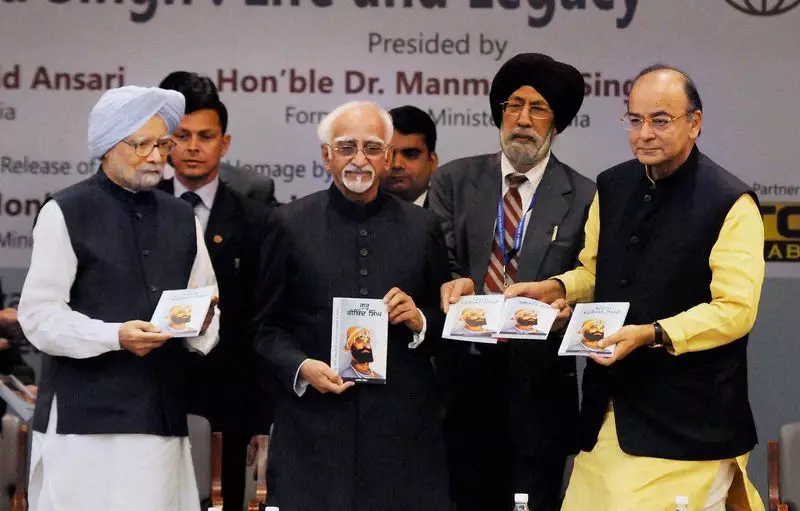
The recent heartfelt tribute by Congress leader Jairam Ramesh, describing former Prime Minister Dr. Manmohan Singh as "the authentic gentleman" of Indian politics, has resonated deeply across the political spectrum. This characterization goes beyond mere politeness, encapsulating a legacy defined by intellectual rigor, unwavering integrity, and a quiet, dignified demeanor that set him apart in the often tumultuous arena of public life.
A Legacy Forged in Humility and Scholarly Excellence
Dr. Manmohan Singh's journey is a testament to the power of substance over style. Born on September 26, 1932, in Gah, Punjab (now in Pakistan), his rise from humble beginnings to the nation's highest executive office is an inspirational narrative. His academic credentials are formidable: an Economics Honours degree from Panjab University, followed by degrees from Cambridge and a doctorate from Oxford. This scholarly foundation was not for mere ornamentation; it became the bedrock of his policy-making.
Before becoming the 14th Prime Minister of India from 2004 to 2014, Singh held pivotal roles that shaped the nation's economic destiny. As the Governor of the Reserve Bank of India and later as the Finance Minister under Prime Minister P.V. Narasimha Rao in 1991, he was the chief architect of India's landmark economic reforms. These policies, which liberalized the economy, are widely credited with pulling India back from a fiscal crisis and setting it on a path of accelerated growth. Throughout this period of radical change, his conduct remained consistently measured, respectful, and devoid of personal grandstanding.

The Gentleman's Conduct in the Political Arena
What truly defines the "authentic gentleman" in Manmohan Singh's case is his conduct under immense pressure. He led a coalition government, the United Progressive Alliance (UPA), which required constant negotiation and compromise. Despite fierce criticism and political attacks, he rarely engaged in personal vitriol or public rebuttals that targeted individuals. His speeches in Parliament were detailed, factual, and reflective of a deep understanding of complex issues, whether related to the nuclear deal, economic policy, or social welfare schemes.
His demeanor was a hallmark of his tenure. In an environment where loud rhetoric often dominates, Singh's quiet, almost reticent style was frequently misunderstood as weakness. However, his colleagues and many observers saw it as a strength rooted in confidence and civility. He listened more than he spoke, a quality that earned him respect even from political adversaries. The image of him sitting calmly in the Lok Sabha, often with eyes closed in deep concentration, became iconic of a leader who processed information thoughtfully before responding.
Contrasting Leadership Styles and Enduring Values
Jairam Ramesh's praise inevitably invites a contrast with the current political climate, often characterized by more aggressive and confrontational styles of communication. The tribute underscores a yearning for a political discourse where respect, humility, and intellectual honesty are not seen as liabilities but as essential virtues of governance. Singh's legacy presents a powerful counter-narrative: that one can wield significant power without sacrificing courtesy, and can drive transformative change without resorting to divisive language.
His contributions extend beyond economics. As Prime Minister, he oversaw the enactment of transformative rights-based laws like the Right to Information Act, the Mahatma Gandhi National Rural Employment Guarantee Act (MGNREGA), and the Right to Education Act. These were monumental pieces of legislation aimed at empowering citizens and strengthening the social fabric, pursued with the same quiet determination that marked his economic stewardship.
The Lasting Imprint of a Dignified Statesman
In retirement, Manmohan Singh has maintained his characteristic dignity, offering counsel sparingly and avoiding the fray of daily political commentary. This consistency reinforces the authenticity of his persona. He is not a gentleman by political convenience but by ingrained character. For a generation of Indians and for aspiring politicians, he stands as a rare model of probity and grace under pressure.

The tribute, therefore, is more than just a kind word for a former Prime Minister from his own party. It is a reflection on the qualities society values in its leaders. In celebrating Dr. Manmohan Singh as the "authentic gentleman," the discourse highlights a profound appreciation for a leadership style that combines monumental achievement with personal humility, sharp intellect with deep respect for institutions, and resilient conviction with an unshakeable moral compass. His legacy is a reminder that in the long run, character and conduct resonate as powerfully as political victories.