

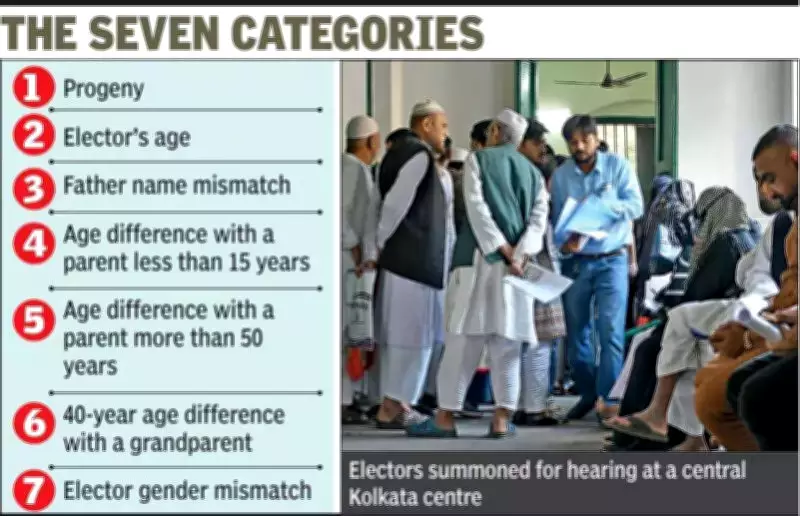
In Kolkata's Jorasanko neighborhood, resident Sharique Aman, aged 38, stood in a queue at Mutty Lall Seal's Free College on Wednesday for his Summary Revision of Electoral Rolls (SIR) hearing. This followed an Election Commission (EC) notice questioning why his father was listed as 'Aman Ali' in the 2002 SIR rolls but appeared as 'Top Aman Ali' in the 2025 draft rolls.
AI Misinterpretations Lead to Confusion
The Aman family resides on the top floor of their Jorasanko home, and it appears that artificial intelligence (AI) deduced the prefix 'Top' from address details mentioned in the 2002 SIR list. Sharique Aman expressed his frustration, pointing to the 2002 records. "My father's name is clearly stated as 'Aman Ali' in the 2002 SIR rolls, but they sent me a hearing notice, saying his name appears as 'Top Aman Ali' in their system. Is this our fault? We live on the top floor, which was stated in 2002, but if the AI misunderstood, what can we do?" he lamented.
Similar Grievances from Other Residents
Another Jorasanko resident, Md Shahnawaz, 34, was visibly angry as he headed to the hearing center. An extra 'F' had appeared before his father's name on the draft list, originating from their address 'F-second floor'. "The 'F' was in our address as 'F-second floor', but it appeared as 'F Abdul Rajjak'. What can we do if technology made such a mistake?" he questioned.

EC's Criteria for Logical Discrepancies
The Election Commission has been summoning residents for hearings based on "logical discrepancies" in electors' details, categorized into seven types:
- When more than six people list the same person as a parent.
- If the elector's age exceeds 45 years and they were not on the 2002 SIR list.
- When a person's father's name in the 2025 draft list does not match the 2002 SIR rolls.
- If the age difference between an elector and their parent is over 50 years or less than 15 years.
- When the age difference between an elector and a grandparent is less than 40 years.
- Gender mismatch in records.
Residents Claim Fault Lies Elsewhere
However, many residents argue that not all discrepancies are their fault, blaming officials or AI for lacking context. Bidit Mukherjee, a university professor, was summoned to prove he is the son of Ashani Mukhopadhyay, a former chairman of Barasat Municipality. "How can 'Mukherjee' and 'Mukhopadhyay' be considered a logical discrepancy? I was summoned for something that is nothing but illogical," he stated.
Similar issues affected Hazra resident Spandan Bhattacharjee, called for a hearing on January 29 because his father's name appeared as Ashok Bhattacharyya in the 2002 list. Tapan Ray also faced a summons as his father's name was listed as Amar 'Roy' in 2002, with Ray noting, "Everyone, except the EC, seems to know that 'Ray' and 'Roy' are spelt differently but are actually the same surname."
Systemic Flaws in EC's Approach
Shahbaz Ajmal, 36, from Jorasanko, was called for a hearing because five others listed his father as their parent. "But that's natural as we are six siblings. Why didn't they check the address, which is the same for all those six?" he asked. Additionally, the EC software flagged electors with middle names like 'Kumar' and 'Chandra' as discrepancies when they appeared as 'Kr' and 'Ch' in the 2002 rolls.
Scale of the Issue
Among the 7 crore electors in the draft SIR rolls, the EC initially identified nearly 1.7 crore voters with logical discrepancies. This number was later reduced to 1.4 crore and further down to 1.2 crore. An EC official reported that as of Tuesday, 1.2 crore out of 1.5 crore hearings were completed, with documents of 95 lakh people uploaded and 55 lakh verified.
The situation highlights growing concerns over the reliance on AI and automated systems in electoral processes, with Kolkata residents bearing the brunt of these technological errors.






