

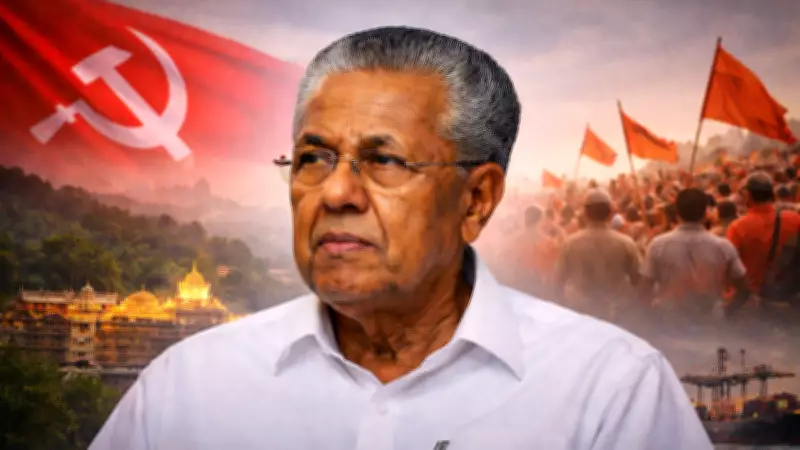
Kerala's Left Confronts Ideological Shifts Amid Communal Controversies
Kerala Chief Minister Pinarayi Vijayan has strongly condemned Assam Chief Minister Himanta Biswa Sarma's recent video remarks, labeling them as "communal hate mongering." This criticism comes just weeks after Vijayan himself faced controversy for supporting a communally charged statement within his own state, highlighting a growing tension within Kerala's political landscape.
The Secular Image Under Strain
For decades, Kerala's Left Democratic Front (LDF), led by the Communist Party of India (Marxist), has projected itself as an ideological outlier in Indian politics—firmly secular, class-driven, and resistant to the communal polarization reshaping much of the country. Alternating in power with the Congress-led United Democratic Front (UDF), the CPM built its dominance on welfare politics, robust grassroots organization, and a clear rejection of identity-based mobilization.
However, as Kerala approaches another high-stakes electoral cycle in 2026, this self-image appears increasingly strained. Recent years have seen the Left navigating a far more complex political terrain, marked by anti-incumbency pressures after two consecutive terms, the steady expansion of the Bharatiya Janata Party's footprint, and shifting demographic calculations.

Strategic Recalibration and Communal Rhetoric
In response to these challenges, the LDF's politics has begun to display sharper edges. This includes strategic outreach to majority sentiment, selective engagement with religious institutions, and a willingness to deploy rhetoric it once distanced itself from. A spate of communally charged statements and controversies has moved to the center of Kerala's political discourse, raising questions about whether the Left is merely reacting to new political threats or consciously adopting elements of the very playbook it long criticized.
Jamaat and the Marad Riots Controversy
The socio-Islamic organization Jamaat-e-Islaami Hind has found itself at the center of a political storm in Kerala, with the focus sharpening on the surge of communal rhetoric accompanying the controversy. The CPM and BJP accused the Congress-led UDF of accepting support from Jamaat, whose political wing, the Welfare Party of India, maintains a presence across social, religious, and educational institutions.
CPM leader AK Balan escalated tensions with a communally charged statement, warning that if the Congress alliance came to power, Jamaat would control the state's home ministry, potentially leading to a repetition of incidents like the Marad riots of 2002-03. Chief Minister Pinarayi Vijayan voiced support for Balan's remarks, but the CPM's top leadership later attempted damage control, describing them as Balan's "personal view" after facing criticism for rhetoric echoing "Sangh Parivar" campaigns.
Congress leader KC Venugopal framed the controversy as a troubling departure from the CPM's professed secular stance, stating, "What the CM has said is a kind of communalism that even Sangh Parivar does not express." CPM leader MV Govindan pushed back, arguing that criticism against religious fundamentalists is not against religion, citing Mahatma Gandhi as a true believer and Nathuram Godse as a religious fanatic.
Dual-Track Political Strategy
Even as the Left sharpened its outreach to the majority community, it simultaneously moved to reinforce ties with influential Muslim bodies, notably Samastha. The nomination of Samastha Mushawara member Ummer Faizi Mukkam to the reconstituted Kerala State Waqf Board underscored this calibrated dual-track approach, aimed at strengthening engagement with sections sympathetic to or seeking distance from the Indian Union Muslim League.
Global Ayyappa Sangamam and Sabarimala
The Left government's organization of the Global Ayyappa Sangamam event last year raised eyebrows, given its previous support for the Supreme Court's 2018 verdict allowing women of all ages to enter the Sabarimala temple. The government had provided police protection to two women of menstruating age who entered the temple, triggering protests from groups like Sabarimala Karma Samithi and the BJP.

By 2019, the Left government took a U-turn, fearing that aggressively facilitating women's entry could trigger unrest and be politically costly. The move to organize the Ayyappa event is seen by the opposition as "majority appeasement," with the CPM receiving backing from influential community organizations like the Nair Service Society, which led the 2018 agitation against the Vijayan government.
The Sabarimala gold theft case, involving alleged pilferage from the temple's inner shrine, has added to the controversy, with the opposition accusing the Left government of investigative lapses.
Vizhinjam Port and Policy Shifts
The Vizhinjam port project illustrates another significant shift in the Left's stance. In 2015, the UDF government laid the foundation stone for the port, with Adani Ports and Special Economic Zone signing an agreement to build and operate it for 60 years. The LDF, then in opposition, rejected what it called a 'sell-out' public-private partnership framework.
By 2025, the LDF government, led by CM Pinarayi Vijayan, shared the stage with Gautam Adani to congratulate the "excellent execution of this mission." Despite sustained protests by fisherfolk and environmental groups, the government stood firmly behind the project, contesting legal challenges and meeting protests with police action. The CPM's mouthpiece Deshabhimani branded the agitation as violent and motivated by vested interests, effectively shifting blame from the project to protesters.
Electoral Pressures and Anti-Incumbency
Anti-incumbency has historically been a decisive factor in Kerala politics, with the LDF experiencing sharp swings after being in power. The electoral record shows that voter fatigue and anti-incumbency are embedded in Kerala's political DNA, particularly against fronts seeking consecutive terms. Having governed since 2016 and securing 94 seats in 2021, the Left is now eyeing a third consecutive term, a period historically vulnerable to voter backlash.
Rise of the Saffron Wave
Another major challenge is the steady rise of the BJP's influence in Kerala over the past two decades. The BJP opened its account in the state in the 2024 Lok Sabha elections, winning its first-ever parliamentary seat and raising its vote share to 19.4%. The CPM, which once commanded double-digit representation from Kerala, was reduced to just one seat for the second consecutive general election, highlighting a prolonged erosion of influence.
Local body polls reinforced concerns about the growing saffron wave ahead of the 2026 assembly elections. In Thiruvananthapuram, the BJP-led NDA ended the CPM's three-decade grip on the city corporation, emerging as the single-largest front with 50 of 100 wards. Prime Minister Narendra Modi hailed the result as a watershed moment in Kerala politics, underscoring how the saffron surge has moved from the periphery to the center of the state's political contest.
Demographic Calculations and Political Strategy
Demographically, Hindus constitute 54.73% of Kerala's population, while Muslims account for 26.56% and Christians 18.38%. As the Left confronts shrinking margins and the rise of new competitors, especially in Hindu-majority regions, it has increasingly sought to complement its long-standing minority outreach with calibrated appeals to the majority community, reflecting a strategic recalibration in response to evolving political realities.





