

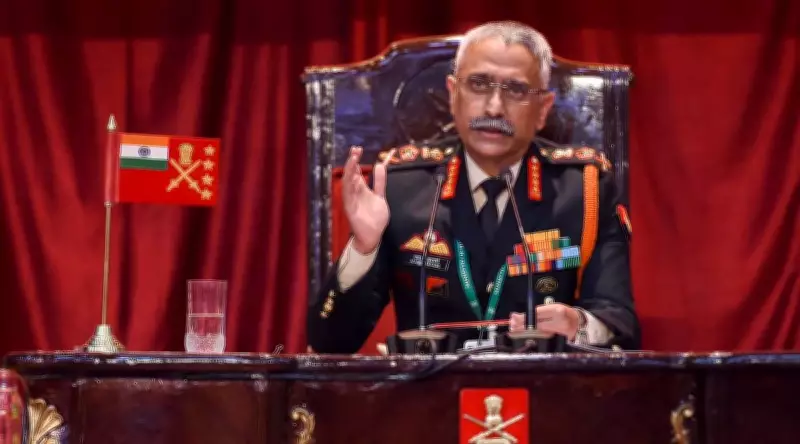
Parliamentary Uproar Over Unpublished Army Chief Memoir
Proceedings in the Lok Sabha were dramatically disrupted on Monday following a contentious incident involving Leader of Opposition Rahul Gandhi. The political storm erupted when Gandhi was prevented from quoting excerpts from the unpublished memoir of former Army chief General M M Naravane during parliamentary discussions. The government firmly maintained that such actions violated established parliamentary rules and protocols.
The Controversial Book: Four Stars of Destiny
General Naravane's memoir, titled Four Stars of Destiny, chronicles his tenure as Army chief from 2019 to 2022 and contains potentially sensitive revelations about critical national security events. The book was originally scheduled for publication in January 2024, but its release has been indefinitely delayed due to an ongoing review process conducted by the Indian Army. Publisher Penguin Random House has been explicitly instructed not to share any excerpts or digital copies until this comprehensive review concludes.
The Ministry of Defence is reportedly involved in this vetting exercise at various levels, though neither the publisher, the author, nor the ministry has issued any official statements regarding the current status of the publication. Multiple attempts by media organizations to contact both Penguin Random House publisher Milee Ashwarya and General Naravane himself have yielded no responses, adding to the mystery surrounding the book's fate.

The August 2020 Ladakh Crisis: Revealing Details
In December 2023, news agency PTI published extracts from General Naravane's memoir that shed new light on the tense border situation with China. The revelations focus particularly on events of August 31, 2020, when Chinese People's Liberation Army tanks and infantry began moving toward Rechin La along the Line of Actual Control in eastern Ladakh.
The Tense Night of Decision-Making
According to the memoir, General Naravane first received an urgent call from Northern Command chief Lieutenant General Y K Joshi at 8:15 PM on August 31, 2020. Lieutenant General Joshi reported that four Chinese tanks supported by infantry were slowly advancing up the track toward Rechin La. Despite firing an illuminating round, the Indian forces had no effect on stopping the movement, and clear orders prohibited opening fire without authorization from the highest levels.
The former Army chief describes a frantic series of telephone calls made to key national security officials, including Defence Minister Rajnath Singh, External Affairs Minister S Jaishankar, National Security Advisor Ajit Doval, and Chief of Defence Staff General Bipin Rawat. To each official, General Naravane posed the same urgent question: "What are my orders?"
By 9:10 PM, the situation escalated further as Northern Command reported the tanks had continued advancing and were now less than one kilometer from the top position. Telephone lines buzzed with activity as the crisis intensified, with General Naravane making another urgent call to the Defence Minister at 9:25 PM, once again requesting clear directions.
The Critical Turning Point
Following an exchange of hotline messages, Chinese PLA commander Major General Liu Lin suggested that both sides should halt further movements and that local commanders should meet at the pass at 9:30 AM the following morning. General Naravane conveyed this development to Defence Minister Singh and NSA Doval at 10 PM.
However, the situation took another dramatic turn just ten minutes later when Lieutenant General Joshi reported that the Chinese tanks had resumed movement and were now only about 500 meters away. General Naravane immediately conveyed the criticality of the situation to Defence Minister Singh, who promised to respond after consultation.
At approximately 10:30 PM, the Defence Minister returned with what General Naravane describes as a pivotal moment: "He said that he had spoken to the PM and that it was purely a military decision. 'Jo ucchit samjho woh karo' (Do whatever you deem is appropriate). I had been handed a hot potato. With this carte blanche, the onus was now totally on me. I took a deep breath and sat silently for a few minutes. All was quiet save for the ticking of the wall clock."

Broader Context of the Military Standoff
The military standoff between India and China that began in April 2020 continued until October 2024, when both nations mutually agreed to disengage from legacy friction points along the Line of Actual Control in eastern Ladakh. This agreement followed multiple rounds of military and diplomatic-level talks aimed at de-escalating tensions.
Before the October 2024 agreement, disengagement of troops had been carried out at certain patrolling points, though a comprehensive de-escalation of military presence in eastern Ladakh remains incomplete. The prolonged nature of this standoff underscores the significance of the events described in General Naravane's memoir.
Regulatory Framework for Military Publications
The controversy surrounding General Naravane's memoir highlights the complex regulatory environment governing publications by military personnel. Currently, serving officers of the Armed Forces and bureaucrats operate under specific rules regarding book publishing. However, for retired officers like General Naravane, the situation exists in a regulatory grey area.
Existing Rules and Their Application
Section 21 of The Army Rules, 1954, explicitly states that no person under the Act shall publish any material relating to political questions, service subjects, or containing service information without prior sanction from the Central Government or designated officers. This prohibition extends to books, letters, articles, or any other documents containing such information.
While these rules may not apply to Armed Forces personnel writing about topics unrelated to their work or of purely literary or artistic nature, the situation becomes more complicated for retired officers with access to sensitive information during their service.
Although no specific rules exist for retired Army officers, defence sources point to the Central Civil Services (Pension) Rules, 1972, which were amended in June 2021 by the Department of Personnel and Training. These amended rules bar retired government servants who served in intelligence or security-related organizations from publishing any organization-related information after retirement without prior permission.
While the three military services are not formally covered under these specific rules, defence sources suggest that retired Armed Forces personnel should adhere to similar expectations regarding sensitive information disclosure. As one source explained, "A top services officer is privy to a lot of confidential information, and so, if they are documenting it in a book or article, it might need prior government sanction."
The Author's Perspective
General Naravane has previously expressed his personal satisfaction with the writing process, telling The Indian Express, "I have enjoyed writing this book and that is what matters. The satisfaction has come from writing it." During a session at the Khushwant Singh Literature Festival in Kasauli in October 2025, he clarified that his responsibility ended with writing the book and submitting it to the publisher, who then assumed the responsibility of obtaining necessary permissions from the Ministry of Defence.
The former Army chief noted that the publisher and the Ministry of Defence maintain constant communication regarding the review process, stating, "So it is not for me to follow up. The ball is in the publisher's and the MoD's court. But I enjoyed writing the book, for better or for worse. And that's that. It is for the MoD to give permission as and when they deem fit."
This ongoing controversy underscores the delicate balance between transparency, national security considerations, and the rights of retired military officers to share their experiences while protecting sensitive operational information.





