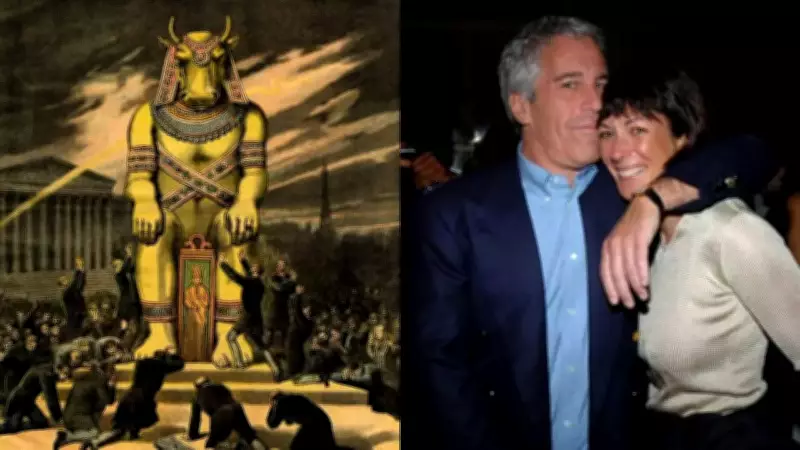
The Enduring Fascination with Hidden Meanings and the Unknown
Humanity has perpetually grappled with phenomena that lie beyond ordinary perception and straightforward explanation. For countless generations, individuals and societies have sought to interpret the enigmatic: from enigmatic deities and clandestine ceremonies to covert hierarchies of influence. While certain enigmas diminish as eras pass, others re-emerge in startling and unforeseen contexts.
This deep-seated urge to uncover concealed significance elucidates the enduring narratives surrounding angels and demons, the consistent popularity of horror entertainment, and the pervasive suspicion that immense power and riches might occasionally be connected to forces considered profane or sinister. It is precisely this cultural undercurrent that caused a recent rumor associated with the Jeffrey Epstein documents to ignite fervent discussion across the digital landscape.
The Viral Spark: 'Baal' in the Epstein Files
A scanned document, circulating widely online and purported to be from the Epstein files, appeared to show a connection between the convicted sex offender Jeffrey Epstein and a bank account referencing the name "Baal." The image, resembling a fax or financial document, displayed the text 'Baal.name' on a line typically reserved for a bank's name, followed by 'Wachovia Bank'. The associated account was listed under 'One Clearlake Centre, LLC.'

This discovery triggered an immediate explosion of speculative theories. For many online observers, this seemed like potential evidence linking Epstein to occult practices or secretive cult worship. Social media posts, including one on X, claimed, "Reports suggest Jeffrey Epstein used a bank account named 'Baal' for financial transactions... 'Baal' is referenced in biblical texts as a pagan deity." The implication was clear: a direct, sinister connection was being drawn.
Unraveling the Ancient Identity of Baal
But who, or what, is Baal? Contrary to modern demonic associations, Baal's origins are deeply rooted in ancient Middle Eastern religion. The name itself translates to "owner" or "lord" in Hebrew. Primarily worshipped by the Canaanites, Baal was a major fertility deity, revered as the Prince, Lord of the Earth, and also known as the Lord of Rain and Dew.
In various ancient cultures:
- In Ugaritic and Hebrew traditions, he was venerated as a powerful storm god.
- The Phoenicians knew him as Baal Shamen, the Lord of the Heavens.
- His mythological dwelling was believed to be Mount Zaphon (modern Jebel Aqra on the Syria-Türkiye border).
The Old Testament frequently references Baal, portraying him as the principal rival to Yahweh, the god of the Israelites. Our most detailed knowledge comes from Ugaritic texts, which narrate his epic battles: his victory over Yamm, the sea god, for dominion over the earth, and his subsequent entrapment by Mot, the god of death, in the underworld. He was later rescued by his consort Anat, who slew Mot, allowing Baal to return and restore fertility to the land.
Archaeological evidence, such as a tablet discovered in 1928 at Ugarit in Syria, depicts Baal as a warrior adorned with a horned helmet, wielding a mace. His worship was characterized by sensual rituals, including temple prostitution and, according to some accounts, even human sacrifice. The cult reached its zenith in Israel during the reign of King Ahab and Queen Jezebel. Later, in the New Testament, Jesus' reference to Satan as "Beelzebub" further cemented the link between Baal and demonic figures in Western thought.
Fact-Checking the Epstein Connection
Despite the tantalizing narrative, investigative reports and document analysts offer a more mundane explanation. According to fact-checking outlets like Lead Stories, the text 'baal.name' is most likely a corrupted or garbled version of the phrase 'bank name' within the document's data field. This technical glitch or scanning error provides a plausible, non-supernatural reason for its appearance.

However, given the horrific nature of Epstein's crimes—operating a "cult-like" network to sexually abuse underage girls—many find the leap to occult symbolism emotionally resonant. Epstein pleaded guilty to state charges in 2008, served prison time, and was a registered sex offender. In 2019, he was indicted on federal sex trafficking charges but was found dead in his prison cell before trial. The recent release of court documents has reignited scrutiny of his actions and associations with high-profile figures like Bill Clinton, Donald Trump, and Prince Andrew.
Adding another layer to the speculation, other released emails revealed Epstein procured three pieces of the Kiswa, the sacred cloth covering the Kaaba in Mecca, shipped from Saudi Arabia to the United States in 2017. This led some to question if these artifacts were intended for rituals connected to a deity like Baal.
The Lasting Allure of Dark Conspiracies
Ultimately, the "Baal" account rumor highlights a powerful human tendency: to weave complex, hidden narratives around shocking events and infamous individuals. While the factual evidence points toward a probable clerical error, the ancient, dark mythology of Baal provides fertile ground for conspiracy theories. The story underscores how modern scandals involving power, abuse, and secrecy can easily become intertwined with age-old symbols of the forbidden and the occult, creating a compelling, if unverified, story that captures the public imagination.