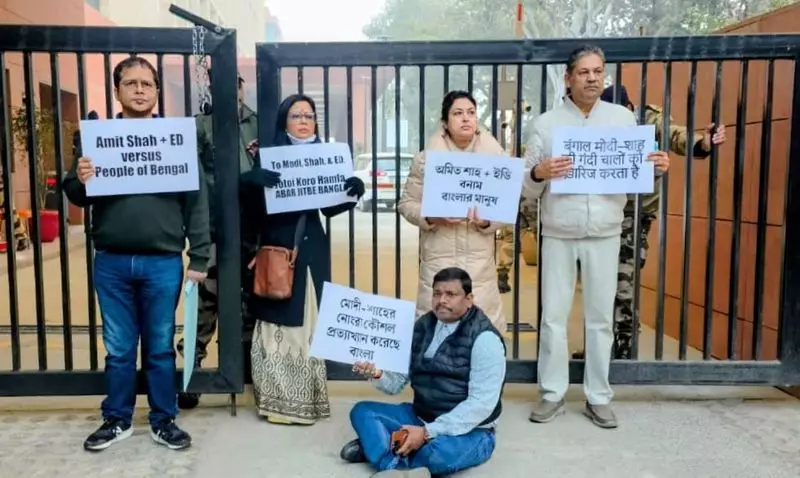
The political landscape in India witnessed a dramatic escalation on Thursday as the Enforcement Directorate (ED) launched simultaneous raids on offices linked to the Indian Political Action Committee (I-PAC), the prominent political consultancy. The action triggered immediate and fierce protests from leaders of the Trinamool Congress (TMC), who gathered outside the residence of Union Home Minister Amit Shah in Delhi, only to be swiftly detained by the police.
Simultaneous ED Raids Target Political Consultancy
According to official sources, the federal probe agency carried out search operations at premises connected to I-PAC in the national capital, Delhi, and in Gujarat. The raids are reportedly part of an ongoing money laundering investigation. The I-PAC, founded by political strategist Prashant Kishor, has been closely associated with several major political parties across India, most notably the Trinamool Congress in West Bengal.
The precise details of the case under which the searches were conducted have not been fully disclosed by the ED. However, the timing and target of the raids have injected fresh volatility into the already charged political atmosphere, with the opposition accusing the central government of using investigative agencies to target its rivals.

TMC Leaders Detained After Protest at Shah's Residence
In a swift reaction to the ED's actions, a delegation of senior Trinamool Congress leaders, including Members of Parliament, marched to the official residence of Home Minister Amit Shah on Thursday afternoon. The leaders intended to register their strong protest against what they termed as "political vendetta" and the "misuse of central agencies" against entities connected to the opposition.
The protest, however, was short-lived. Delhi Police personnel, citing security protocols and potential law and order issues, intervened and whisked away the demonstrating TMC leaders from the high-security zone. The leaders were reportedly taken to a nearby police station before being released later. This move further fueled the political controversy, with the TMC alleging high-handedness and suppression of democratic protest.
Political Fallout and Accusations Fly
The twin events—the ED raids and the subsequent detention of protesting politicians—have ignited a major political firestorm. The Trinamool Congress has launched a scathing attack on the Bharatiya Janata Party (BJP)-led central government. Senior TMC leaders have framed the raids as a direct assault on the party and its associates, meant to destabilize them ahead of future electoral battles.
Conversely, supporters of the action argue that the Enforcement Directorate is merely performing its duty by investigating potential financial irregularities, irrespective of the political affiliations of those involved. They maintain that the rule of law must prevail and that investigative agencies should be allowed to function without political interference.
The incident underscores the deepening tensions between the ruling dispensation at the Centre and key opposition parties like the TMC. It also brings into sharp focus the increasingly contentious role of central investigative agencies in India's political discourse, with accusations of their weaponization becoming a frequent rallying cry for the opposition.
As the dust settles on Thursday's dramatic events, the political ramifications are likely to reverberate for days to come. The opposition is expected to unite in its criticism of the government's actions, while the ruling party will likely defend the independence of the ED. The episode marks another contentious chapter in the ongoing political tussle between the BJP and its rivals.