ECI Announces 2026 Assembly Election Schedule for Five States and Union Territory
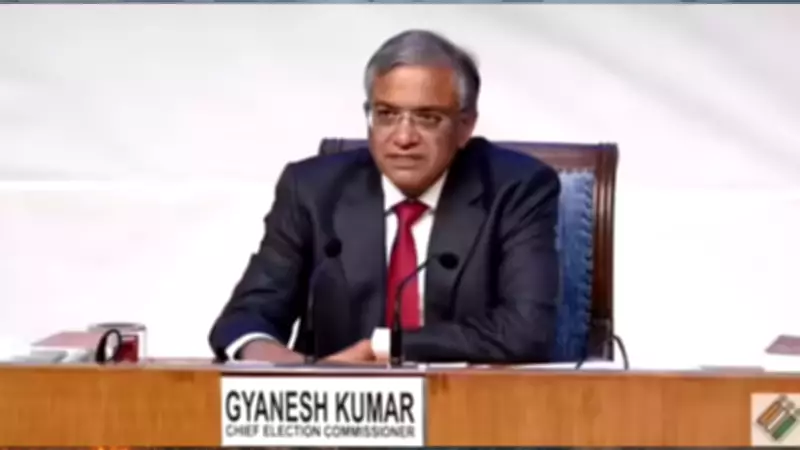
The Election Commission of India (ECI) has officially announced the schedule for the highly anticipated 2026 assembly elections covering five states and one Union Territory. The announcement came during a press conference held at 4 PM, where Chief Election Commissioner Gyanesh Kumar, along with Election Commissioners Sukhbir Singh Sandhu and Vivek Joshi, revealed the detailed polling dates and phases.
Polling Schedule and Phases
The upcoming elections will be conducted across West Bengal, Assam, Tamil Nadu, Kerala, and the Union Territory of Puducherry. In a significant development, the elections are expected to be held over fewer phases compared to the 2021 elections. West Bengal, which previously voted across eight phases, and Assam, which had three phases, will see reduced multi-phase polling this time. Meanwhile, Tamil Nadu, Kerala, and Puducherry are likely to witness single-phase polling, streamlining the electoral process.
The announcement follows extensive preparations by the Election Commission, including special intensive revisions of voters' lists in all poll-bound regions. Final electoral rolls have already been published, with West Bengal's roll covering over 6.4 crore voters as of February 28. The commission has been actively reviewing poll preparedness through visits to all states and the Union Territory earlier this month.

Security Arrangements and Electoral Management
To ensure free and fair elections, the ECI has planned substantial security measures. A massive deployment of Central Armed Police Forces (CAPFs) is anticipated, with over 1,500 companies (approximately 1.4 lakh personnel) potentially mobilized. This deployment surpasses the security arrangements made for the 2024 Jammu & Kashmir polls, highlighting the commission's commitment to maintaining law and order.
The Election Commission has appointed Central Observers under Article 324 of the Constitution and Section 20B of the Representation of the People Act, 1951. These observers will oversee electoral management at the field level and monitor polling conduct. Additionally, the commission will continue adjudicating approximately 60 lakh doubtful voter cases in West Bengal, with supplementary voter lists to be published after judicial approval.
Political Landscape and Key Contests
The elections are shaping up to be highly competitive across all regions:
- West Bengal: The primary contest is between Mamata Banerjee's Trinamool Congress (TMC) and the Bharatiya Janata Party (BJP) for 294 assembly seats.
- Assam: The incumbent BJP-led National Democratic Alliance (NDA) faces the Congress for 126 assembly seats.
- Kerala: The main battle is between the Left Democratic Front (LDF) and the United Democratic Front (UDF) for 140 seats, with the BJP-led NDA contesting around 100 seats through allies BDJS and Twenty20.
- Tamil Nadu: Political parties are intensifying campaigns and finalizing seat-sharing for 234 assembly seats, with the DMK-led alliance facing the AIADMK-BJP combine.
- Puducherry: All 30 constituencies will go to polls, with the Congress contesting in alliance with DMK and CPI against opposition from AIADMK, BJP, and All India NR Congress.
Regional Preparations and Statements
Political parties across the poll-bound regions have been actively preparing for the elections. In Kerala, Congress leader Ramesh Chennithala announced that the United Democratic Front (UDF) has completed preparations and will announce candidates soon after the schedule release. Meanwhile, Kerala minister V Sivankutty expressed confidence that the BJP "will not open account" in the state, highlighting the LDF's preparedness.
In Tamil Nadu, the contest revolves around the MK Stalin-led Secular Progressive Alliance, spearheaded by the Dravida Munnetra Kazhagam (DMK), seeking a second consecutive term. The alliance faces the BJP-AIADMK-led National Democratic Alliance in what promises to be a closely watched political contest.

Electoral History and Voter Turnout
Historical data reveals interesting patterns in previous elections. In the 2021 Tamil Nadu Assembly elections, the DMK emerged victorious with 133 seats, while the AIADMK secured 66 seats. The state recorded a voter turnout of 76.6%. In Puducherry, the 2021 elections saw the All India NR Congress emerge as the largest party with 10 seats, with a voter turnout of 84.8%.
Kerala witnessed the BJP's first Assembly win in 2016 at Nemom, though the LDF recaptured it in 2021. These historical trends add depth to the upcoming electoral battles, with parties strategizing based on past performances and current political dynamics.
Administrative Measures and Future Steps
The Election Commission has taken comprehensive administrative measures to ensure smooth elections. Returning officers for all 294 West Bengal constituencies have already been appointed. The commission will continue monitoring voter registration appeals and supplementary lists, particularly in West Bengal where judicial oversight is involved.
With campaign preparations underway and security logistics in place, all political stakeholders await the official polling dates. The elections in these states are shaping up to be a crucial political barometer, reflecting regional dynamics as well as the strategies of national parties in contesting state-level influence. The ECI's announcement marks the formal beginning of what promises to be one of the most significant electoral exercises of 2026.