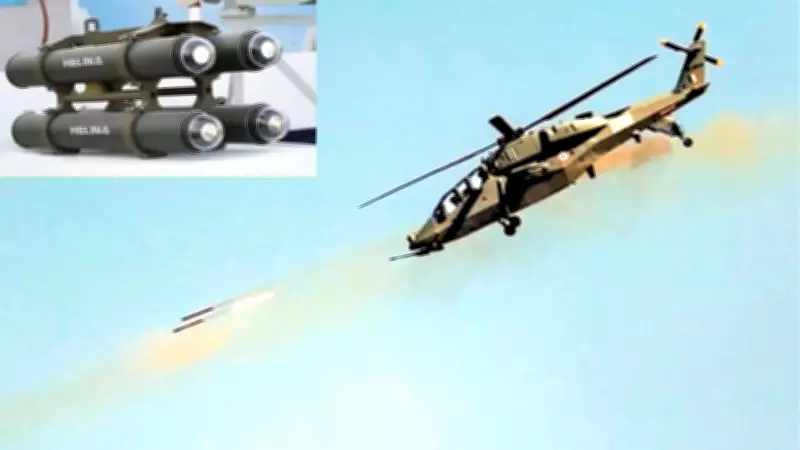
Dhruvastra: India's Indigenous Helicopter-Launched Anti-Tank Missile Transforms Battlefield Strategy
India's pursuit of self-reliance in advanced weaponry has achieved a significant milestone with the induction-ready Dhruvastra, the helicopter-launched version of the Nag anti-tank guided missile. Developed by the Defence Research and Development Organisation, this system represents a major advancement in India's indigenous defense capabilities.
From Nag to Dhruvastra: The Evolution of an Indigenous Missile Family
Dhruvastra, previously known as HELINA, is part of the broader Nag missile ecosystem that originated from India's Integrated Guided Missile Development Programme. The original Nag missile was conceived in the late 1980s under the visionary leadership of A. P. J. Abdul Kalam, with the objective of creating a modern, all-weather anti-tank system capable of top-attack strikes.
Over decades of development, multiple variants have emerged from this platform:

- Land-based Nag missile systems
- NAMICA (Nag Missile Carrier) vehicle-mounted platforms
- Man-portable ATGM versions
- Air-launched variants including Dhruvastra and the more advanced SANT missile
Dhruvastra specifically represents the air-launched evolution optimized for deployment from India's indigenous attack helicopters, including the HAL Rudra and HAL Prachand platforms manufactured by Hindustan Aeronautics Limited.
Precision Strike Capability: Advanced Guidance Systems
At the core of Dhruvastra's operational effectiveness is its third-generation fire-and-forget guidance system. Once locked onto a target before launch, the missile autonomously tracks and destroys enemy armor without requiring further operator intervention.
The system employs an imaging infrared seeker that enables target identification and locking based on heat signatures, even during night operations or adverse weather conditions. This technology provides significant resilience against electronic countermeasures and battlefield interference.
Dhruvastra supports both direct attack and top-attack modes, with the latter allowing strikes against the relatively weaker upper armor of modern tanks—a critical advantage against heavily armored platforms.
Operational Specifications: Range, Lethality and High-Altitude Performance
Dhruvastra boasts an impressive strike range of up to 7 kilometers, substantially extending the engagement envelope compared to land-based Nag variants. This stand-off capability enables attack helicopters to engage enemy armor while minimizing exposure to air defense systems.
Weighing approximately 43 kilograms, the missile has been specifically engineered for operations in rarefied high-altitude environments like those found in Ladakh. Its lightweight configuration ensures that helicopter performance remains uncompromised even in thin air conditions.
In terms of destructive capability, Dhruvastra can penetrate armor thickness of up to 800 millimeters, making it effective against most light and medium armored vehicles deployed in regional theaters.
Advanced Design Features and Survivability
Dhruvastra inherits sophisticated design elements from the Nag platform, including composite airframes that enhance durability and resistance to countermeasures. The missile incorporates several advanced systems:
- Real-time image processing for automatic target recognition
- Centroid tracking mechanism for precise terminal guidance
- Digital autopilot system for stability and control
- Electric actuation system for improved maneuverability
The missile follows a characteristic flight trajectory where it initially climbs before executing a sharp dive onto the target—a path optimized for top-attack strikes against armored vehicles.
Integration with India's Attack Helicopter Fleet
A key operational strength of Dhruvastra lies in its seamless integration with India's indigenous helicopter platforms. Mounted on twin-tube launchers on the stub wings of Rudra and Prachand helicopters, it transforms these aircraft into potent anti-armor assets.

This integration becomes particularly significant as Hindustan Aeronautics Limited expands production of these helicopters. Recent disclosures to parliamentary panels indicate a robust order book including 156 Prachand helicopters, signaling a major expansion in India's rotary-wing combat capability.
With Dhruvastra onboard, these helicopters can perform precision anti-tank missions, close air support, and battlefield interdiction roles with enhanced effectiveness across diverse operational scenarios.
Procurement Push and Induction Roadmap
The Indian government has taken concrete steps to accelerate Dhruvastra's induction into service. In September 2023, the Defence Acquisition Council approved procurement worth approximately ₹700 crore for more than 200 Dhruvastra missiles for the Air Force variant.
Armed forces are expected to induct the missile in phases, with initial demand estimated at 500 units and 40 launcher systems. The projected cost per missile remains under ₹1 crore, positioning it as a cost-effective yet high-performance solution for India's defense needs.
This procurement aligns with India's broader push for indigenization under the 'Aatmanirbhar Bharat' initiative, reducing dependence on imported anti-tank systems such as Konkurs and MILAN missiles.
Strategic Implications: Transforming Anti-Armor Warfare Doctrine
The induction of Dhruvastra is poised to reshape India's anti-armor warfare doctrine significantly. Its ability to engage targets from stand-off distances, combined with precision targeting and high survivability, enhances the effectiveness of India's attack helicopter fleet in both conventional and hybrid conflict scenarios.
In mountainous terrains and border regions where mobility and rapid response are critical, Dhruvastra-equipped helicopters provide a flexible and lethal option against armored threats. The system strengthens India's deterrence posture by demonstrating indigenous capability in advanced missile technologies—a domain traditionally dominated by a handful of global powers.
The Road Ahead: From Dhruvastra to Next-Generation Systems
While Dhruvastra represents a significant milestone in India's defense capabilities, DRDO is already advancing work on next-generation variants such as the SANT missile, which aims to further extend operational range and incorporate millimeter-wave radar seekers.
The evolution from Nag to Dhruvastra and beyond reflects a clear trajectory toward network-centric, precision-guided, and autonomous weapon systems. As India continues expanding its indigenous defense ecosystem, Dhruvastra stands out as a symbol of technological maturity—a weapon system that not only meets operational requirements but also reinforces strategic autonomy in defense manufacturing.