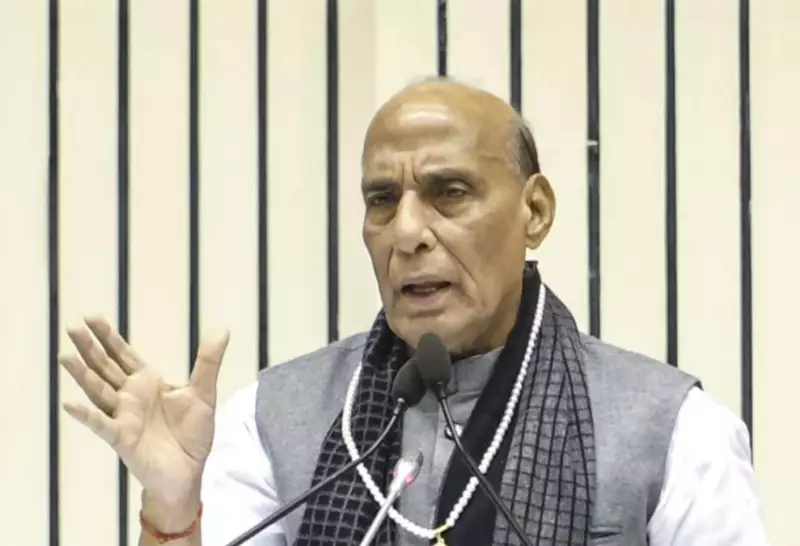
The Indian National Congress has issued a sharp rebuttal to Defence Minister Rajnath Singh's recent remarks about India's first Prime Minister, Jawaharlal Nehru. The party has categorically labeled Singh's claim that Nehru wanted to rebuild the Babri Masjid after its demolition as a complete falsehood.
The Controversial Allegation and Immediate Backlash
During a political event, Defence Minister Rajnath Singh made a significant historical claim. He alleged that Jawaharlal Nehru had expressed a desire to reconstruct the Babri Masjid after it was demolished in 1992. This statement immediately ignited a political firestorm, drawing a swift and forceful response from the principal opposition party.
The Congress party did not mince words in its denial. A senior party spokesperson, Pawan Khera, addressed the media to counter the Defence Minister's assertion. Khera stated unequivocally that Rajnath Singh's claim was a "blatant lie" and had no basis in historical fact. He challenged the minister to provide any documented evidence, such as a letter or official note from Nehru's era, to substantiate the allegation.
Congress Counters with Historical Context
In their detailed response, Congress leaders provided context to dismantle the claim. They pointed out the fundamental chronological flaw in Singh's statement. Jawaharlal Nehru passed away in 1964, nearly three decades before the disputed structure in Ayodhya was brought down on December 6, 1992. This fact alone, Congress argued, makes the allegation historically impossible and politically motivated.
Pawan Khera emphasized that such statements were part of a larger pattern. He accused the ruling Bharatiya Janata Party (BJP) of consistently attempting to distort historical narratives and tarnish the legacy of India's founding leaders for contemporary political gain. The Congress response framed the incident not as a simple disagreement but as a deliberate misinformation campaign.
Political Implications and the Battle of Narratives
This exchange is more than a war of words over historical events. It represents a deep and ongoing ideological battle over India's past and its national identity. The Babri Masjid-Ram Janmabhoomi issue has been one of the most polarizing themes in modern Indian politics, culminating in a Supreme Court verdict in 2019 and the eventual construction of the Ram Temple.
By invoking Nehru's name in connection with the dispute, the BJP leadership is seen as trying to contrast its ideological stance with that of the Congress's foundational secularism. The Congress's aggressive rebuttal is an effort to shield its legacy and counter what it perceives as revisionist history. This incident ensures that historical interpretation remains a live wire in political discourse, with both parties using it to mobilize their respective voter bases.
The controversy erupted on December 3, 2024, and has since gained significant traction in news cycles. With no evidence presented to back the initial claim, the Congress party has positioned itself on the offensive, demanding accountability for the spreading of what it calls a fabricated story. This episode underscores how historical figures and events continue to be potent instruments in India's present-day political confrontations.