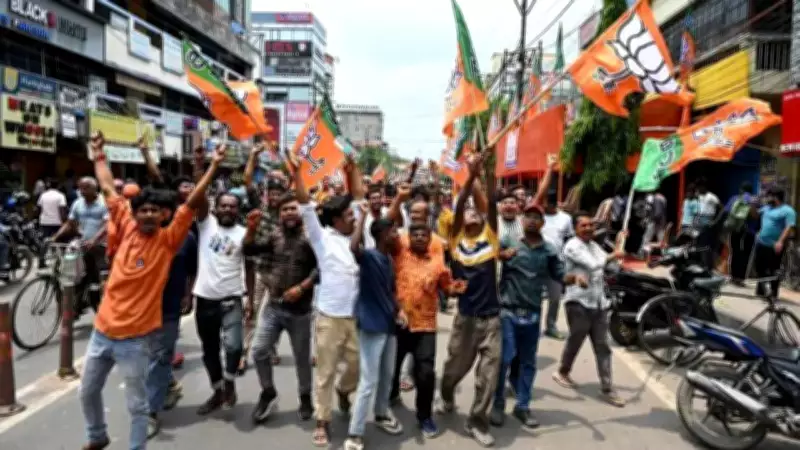
The election results in West Bengal and Assam have presented a significant challenge for the Muslim community, which has been caught in a political whirlpool since 2014. The Bharatiya Janata Party (BJP) has employed a 'communal card' to polarize the majority community, coupled with controversial measures such as delimitation and the Summary Revision of Electoral Rolls (SIR).
Impact of Delimitation and SIR
BJP's success in dampening the influence of the largest minority community in Assam followed the state-specific delimitation in 2023. Estimates indicate that the number of seats where Muslims held sway decreased from 35 out of 126 to just 20. A similar exercise in Jammu and Kashmir created seven new seats, which opposition parties claim were 'tailored' to benefit the BJP. While critics have dubbed this 'legalized rigging', Assam Chief Minister Himanta Biswa Sarma has openly stated that the delimitation was designed to marginalize the influence of the anti-BJP religious group. Both the Assam and Jammu and Kashmir delimitations were flagged by every opposition MP during recent parliamentary debates.
The Election Commission's SIR exercise has also sparked controversy, with the main allegation revolving around the 'disenfranchisement' of Muslims. The combined effect of SIR and delimitation has been compounded by BJP's aggressive campaign focused on polarizing Hindus.

BJP's Electoral Success and Future Strategy
With sweeping verdicts in favor of the BJP in Bengal and Assam—states where the minority population is above the national average and communal outreach became a mobilizational theme—the governing party is likely to be encouraged to intensify its winning formula. This could further test the Muslim community, as it will agitate secular parties that cater to voters across the religious divide. Such situations often lead to secular parties being outflanked from the right, giving rise to outfits exclusively representing minorities. This trend is illustrated by the growth of the All India Majlis-E-Ittehadul Muslimeen (AIMIM) in Bihar's 'Seemanchal' region. AIMIM has sought to play this card in many states, and it remains to be seen what the Hyderabad-based party does in Uttar Pradesh in 2027.
At the same time, this tricky situation could nudge BJP rivals toward diluting their overt secular positioning. A case in point is Assam, where 18 of the 19 Congress winners may be Muslims. Such outcomes can rattle even the most seasoned political players.
Political Chatter and Conspiracy Theories
Beyond delimitation and SIR, political discussions have been rife with what some call a 'conspiracy theory'—that BJP is attempting to strengthen its hand by dividing Muslim votes. For instance, Humayun Kabir launched a new party with an emotive religious card. Such conundrums and surprises will be for the minorities and political rivals to grapple with, while the BJP steps on the gas to consolidate the majority bloc.
Follow the latest election results 2026, live updates, winner lists, constituency-wise results, party-wise trends, and full coverage for Tamil Nadu, West Bengal, Kerala, Assam, and Puducherry elections on Times of India.