Bengal's Mothabari Villagers Flee NIA Probe, May Miss Voting Despite Being on Electoral Rolls
In an ironic and unsettling development, residents of Mothabari in West Bengal's Malda district, who recently protested against potential deletion from electoral rolls, now face the prospect of missing voting altogether. This time, however, it is not because their names are absent from the voters' list, but because they have evacuated the area in fear of being apprehended by the National Investigation Agency (NIA).
Exodus of Men Creates Near-Deserted Villages Ahead of Polls
With the central agency intensifying its investigation into the April 1 gherao of judicial officers, hundreds of men have fled their homes, apprehensive of arrest. This mass departure has transformed villages into near-ghost towns just days before the region votes on April 23 in the first phase of Bengal's two-phased elections.
Two weeks after a midnight standoff in this otherwise obscure pocket drew national attention, Mothabari presents a starkly altered landscape. Doors remain shut throughout the day, courtyards lie empty, and in numerous households, only women, children, and the elderly remain—waiting not for relief, but for the men who have vanished.

"There are six members in our family. All our names were placed under adjudication, so my husband applied to restore our voting rights. He was never part of any violence. Still, police sent him a notice," said Jalili Bibi of Sadipur. "Now, four of our names have been cleared, but he is too afraid to return, even to vote."
A similar narrative unfolds in Jotgopal Kagmari village. Runa Laila's husband, Md Asmaul Basar (39), who operates an e-rickshaw battery shop, is currently on the run. "He wasn't part of any protest. He had gone to deliver an order. Someone has framed him and now the police are looking for him," she lamented. "Voting is no longer our priority. I just want him to be safe."
Arrests and Adjudication Spark Widespread Fear
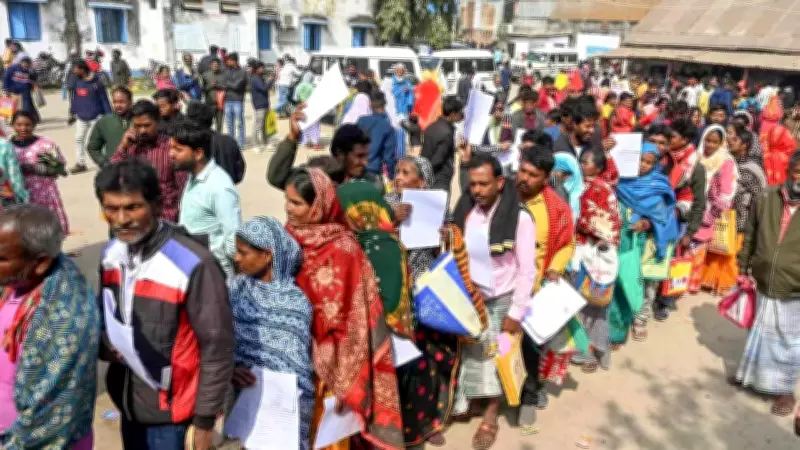
Across West Bengal, approximately 60.6 lakh names were sent for adjudication, with 27 lakh ultimately deleted. In Mothabari alone, 79,683 names were listed for judicial scrutiny, resulting in 37,255 deletions.
The crisis escalated on April 1 when seven judicial officers, including women judges, were gheraoed by an agitated mob. Confined for over nine hours inside a block development office, they were eventually rescued. The incident prompted the Supreme Court to transfer the probe to the NIA on April 6, leading to swift and sweeping repercussions.
To date, at least 52 individuals have been arrested. The NIA has registered 12 cases, with arrests cutting across party lines. An Indian Secular Front (ISF) worker was the first apprehended by the central agency, followed by the arrest of Mothabari ISF candidate Maulana Shahjahan Ali Qadri and AIMIM leader Mofakkerul Islam by the state CID. More recently, two Congress functionaries—close aides of Congress candidate Sayem Chowdhury—were arrested by the NIA.
Chowdhury himself was detained for questioning from Alinagar and released after a night-long interrogation, with his mobile phone seized for forensic analysis. In a video message post-release, he alleged political vendetta and denied any involvement in the violence.
Political Blame Game Intensifies Amidst Voter Absence
Beyond the political sparring, the ground reality in Mothabari is one of palpable fear and quiet desolation. Even as adjudication restored some names, the aftermath of the April 1 violence has erected a new barrier—voters present on paper but absent in person—that no revision process can rectify.
Families report that men have been leaving in batches since the NIA intensified its probe. Some have crossed into other districts, while others are believed to be hiding in neighbouring states. Many have ceased answering phone calls.
"We told them not to stay here," confided a middle-aged woman in Singapara, requesting anonymity. "Even if they are innocent, who will listen? If they are picked up, who will take care of us? His name is back on the voter list, but he won't return to vote," she said of her husband who has fled.

Ground reports indicate that in several pockets, a significant number of adult men are currently missing. While no official count exists, the situation is evidenced by empty village squares, shuttered shops, and an eerie stillness that descends by evening.
Political reactions have only deepened the divide. Prime Minister Narendra Modi described the episode as indicative of a "Maha Jungle Raj," while the Trinamool Congress (TMC) has accused opposition parties of instigating the unrest. The BJP claims to have moved beyond the SIR controversy and is focusing on development issues.
"People here need better roads, clean water, a dedicated women's ward at the government hospital, better schools and hostels," asserted BJP candidate Nibaran Ghosh. "The sitting MLA did little beyond building personal wealth."
Sabina Yasmin, who won this seat for Congress in 2011 and 2016 and on a TMC ticket in 2021, was replaced this time by her new party, which has entrusted Md Najrul Islam with retaining the seat. Islam blamed the BJP for deleting valid voters' names and accused Congress and ISF of spreading fear among villagers. "Congress is trying to help BJP by creating conflict among voters who are still eligible," he alleged.
Congress candidate Chowdhury, however, posited a broader conspiracy. "TMC, BJP and NIA have acted together to target us. People can see what is happening," he stated.
Residents Caught in Crossfire as Original Grievance Overshadowed
Caught in the political crossfire are residents whose initial grievance—the fear of losing their voting rights—now feels eclipsed. "We protested because our names were deleted," said a young voter whose elder brother has fled. "Now, even if the name is there, the person is not."
As dusk falls, the silence deepens. In numerous homes, women gather around mobile phones, anxiously awaiting calls from husbands and sons. For a village that rose in protest to reclaim its place on the electoral roll, the impending election may pass with many of its voters missing—not erased by the system this time, but by the consequences of challenging it.