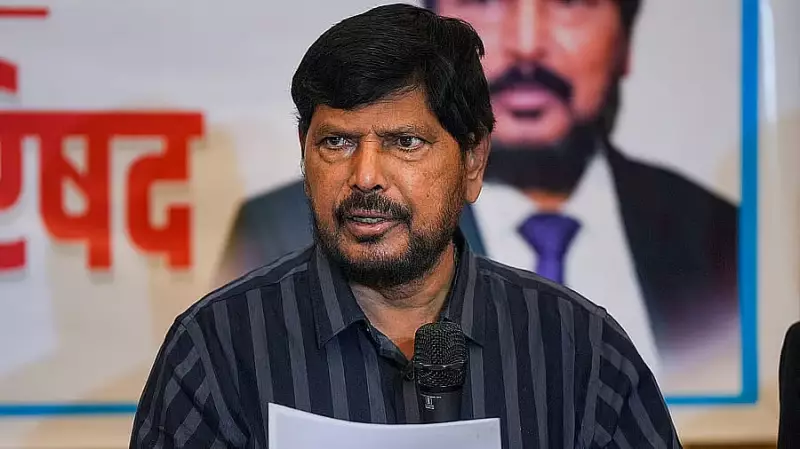
Union Minister Ramdas Athawale has made a significant political statement suggesting that Kerala could potentially receive enhanced financial allocations from the central government if Chief Minister Pinarayi Vijayan decides to align with the National Democratic Alliance (NDA). This remark comes amid ongoing discussions about political alliances and their impact on state development funding.
Political Proposition for Kerala's Development
Athawale, who serves as the president of the Maharashtra-based Republican Party of India (A) and holds a ministerial position in the Union government, articulated this viewpoint during a recent interaction. He emphasized that such a political move could translate into tangible benefits for Kerala in terms of increased central funds and support for various developmental projects across the state.
Call for Left Parties to Join NDA
Beyond addressing Chief Minister Vijayan specifically, Athawale extended his appeal to include the broader Left political spectrum in Kerala. He explicitly mentioned that both the Communist Party of India (Marxist) and the Communist Party of India should consider joining the NDA fold. This suggestion marks a notable attempt to bridge ideological divides and create a more cohesive political framework at the national level.

The union minister's comments highlight the intricate relationship between political alignment and fiscal policy in India's federal structure. States that are part of the ruling coalition at the center often witness smoother coordination and potentially more favorable treatment in resource allocation. Athawale's statement underscores this dynamic, positioning it as an opportunity for Kerala to leverage for its economic advancement.
Context and Implications
Kerala, governed by the Left Democratic Front led by the CPI(M), has historically maintained a distinct political identity separate from the BJP-led NDA. Athawale's proposition, therefore, represents a significant departure from conventional political boundaries. It raises important questions about how state governments navigate their relationships with the central authority to secure optimal funding for infrastructure, welfare schemes, and other public initiatives.
This development comes at a time when states across India are increasingly vocal about their financial needs and the distribution of central resources. The suggestion from a union minister adds a new dimension to the ongoing dialogue about cooperative federalism and the role of political affiliations in shaping developmental outcomes.
While Chief Minister Vijayan and the CPI(M) leadership have yet to respond publicly to Athawale's remarks, the statement has undoubtedly sparked discussions within political circles in Kerala and beyond. It remains to be seen whether this will lead to any formal reconsideration of political alliances or simply remain as a provocative suggestion in India's complex political landscape.