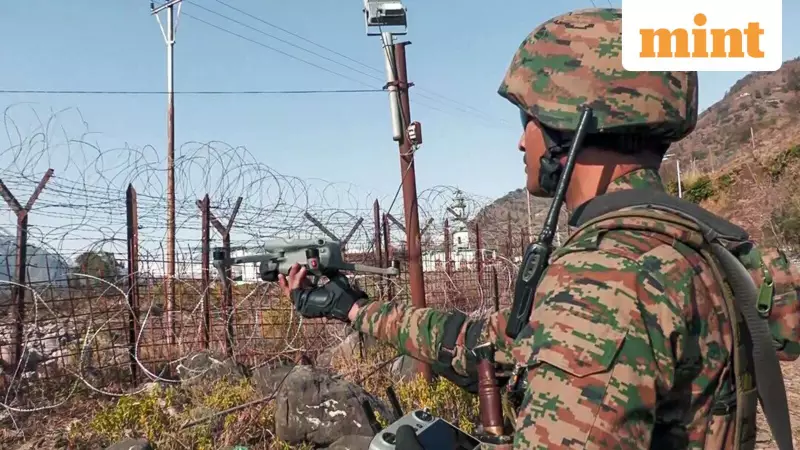
Indian Army Assumes Control of Border Airspace to Thwart Drone Intrusions
In a significant strategic move, the Indian Army has officially taken charge of monitoring all flying objects within a 35-kilometer radius from the country's borders and up to an altitude ceiling of three kilometers. This decisive step aims to effectively counter the growing threat of enemy drone intrusions into Indian territory, particularly amid the proliferation of surveillance and armed drones along the sensitive western and northern borders.
Enhanced Drone and Anti-Drone Operations Post-Operation Sindoor
This initiative represents one of the many comprehensive measures undertaken by the Indian Army following Operation Sindoor, alongside strategic tweaks in deployment and the introduction of specialized rocket regiments. According to reports, the army is currently conducting an impressive 97% of all drone and anti-drone activities within this newly defined 35x3 km air envelope. To bolster this effort, advanced air command and control centers are being rapidly established along the borders with both China and Pakistan.
These centers will serve a dual purpose: not only to meticulously monitor cross-border drone activity but also to coordinate the launch of Indian drones and neutralize any hostile unmanned aerial vehicles. The move comes as a direct response to incidents where Pakistan utilized armed drones, including models of Turkish and Chinese origin, to target Indian Army and Air Force formations during Operation Sindoor. Similarly, the People's Liberation Army (PLA) of China consistently deploys drones across the eastern theatre to monitor Indian military movements along the Line of Actual Control (LAC).

Massive Drone Fleet Expansion and Coordinated Command Structure
Looking ahead, the Indian Army is aggressively working to acquire the operational capacity to deploy over 10,000 drones along the western theatre and more than 20,000 drones across the sprawling 3,488 km Line of Actual Control. To ensure seamless integration and effectiveness, area Corps Commanders will work in close coordination with their counterparts in the Indian Air Force. This collaboration is designed to harmonize efforts between the IAF, intelligence agencies, and other relevant departments, creating a unified and robust defensive and offensive capability.
Comprehensive Military Modernization and Strategic Rebalancing
Beyond aerial surveillance, the army's modernization drive includes substantial ground force enhancements. The Indian Army has already deployed two units of a dedicated rocket force, two combined armed brigades (known as Rudra brigades), and 21 specialized Bhairav battalions. Notably, the operational range of Indian artillery brigades has been dramatically increased from 150 kilometers to an impressive 1,000 kilometers, extending their reach deep across borders.
The establishment of the rocket force is a strategic counter to China's deployment of rocket regiments across the LAC in East Ladakh following its May 2020 transgressions, and Pakistan's use of Fatah-1 and Fatah-2 rockets during Operation Sindoor. The introduction of the Bhairav battalions is specifically aimed at ensuring that Special Forces can be utilized for deep strategic strikes within enemy territory, supported by armed drones, surveillance drones, and loitering ammunition, while the battalions themselves handle tactical roles directly along the border.
Context of Operation Sindoor and Evolving Regional Dynamics
Operation Sindoor was launched by India in the early hours of May 7, targeting terror and military installations within Pakistan and Pakistan-occupied Kashmir (PoK) prior to a ceasefire on May 10. The intense clash involved fighter jets, missiles, armed drones, and a fierce artillery duel. These military developments occur against a backdrop of heightened tensions, including the deadly 2020 Galwan Valley clash that severely deteriorated India-China relations. A formal disengagement process from the last friction points at Demchok and Depsang was finalized on October 21, 2024.

The Indian Army's revised deployment strategy and focus on advanced weaponry are timely and critical. They address the new reality where Pakistan, in the aftermath of Operation Sindoor, has itself acquired an array of advanced military assets including armed drones, sophisticated radars, missiles, and rockets. This ongoing strategic rebalancing underscores India's commitment to maintaining a decisive and technologically superior defensive posture along its volatile frontiers.