Telangana High Court Directs Authorities to Clarify Legal Remedies for Man in Hyderabad
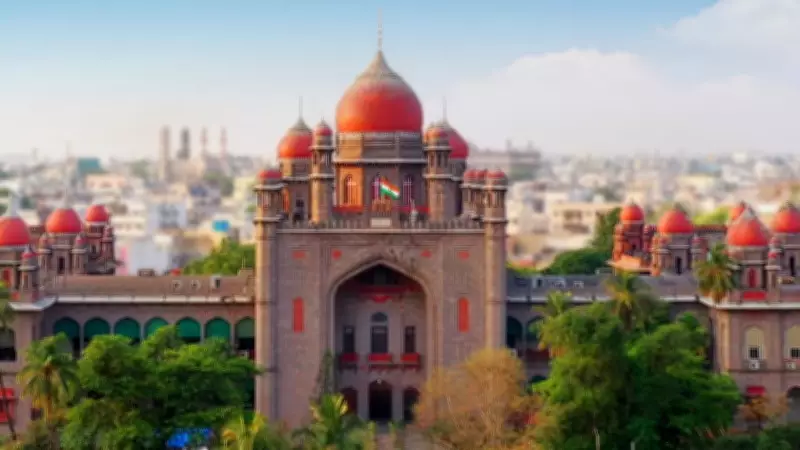
The Telangana High Court has issued a directive to the state Home Department and passport authorities, seeking clarification on the legal pathways available for a 33-year-old man who has resided in Hyderabad for more than three decades without an Indian passport or long-term visa. This individual, Syed Ali Hussain Razvi, is being treated as a Pakistani national by authorities, sparking a complex legal debate over his status and rights.
Background of the Case and Court Proceedings
Razvi claims he was born in Hyderabad and has completed his education there, holding several Indian identification documents, including an Aadhaar card, Voter ID, PAN card, driver's licence, and school leaving certificate. However, he lacks an Indian passport, which has led to his classification as an illegal immigrant by the Special Branch of the Hyderabad police, which handles cases involving Pakistani nationals.
During a hearing before the Division Bench of Chief Justice Aparesh Kumar Singh and Justice G M Mohiuddin, Advocate S Sridhar, representing Razvi, argued that the appellant's mother held an Indian passport at the time of his birth in 1992. Razvi expressed a desire to continue living in India as an Indian citizen but has never applied for an Indian passport or a long-term visa.

The court posed a critical question: "What can be the way out for a person placed in his circumstances? First apply for a long-term visa and then apply for a passport?" In response, Government Pleader Mahesh Raje, representing the Telangana Home Department, stated that if Razvi applies for a long-term visa, he cannot subsequently apply for an Indian passport, highlighting a legal conundrum.
Investigation and Family History
The Special Branch's investigation into Razvi's stay in India has deemed it illegal. His mother, Gohar Fathima, originally an Indian citizen, married a Pakistani national and moved to Pakistan in 1991. After alleged marital issues, she returned to India in 1994 with a Pakistani passport that lists Razvi's name. She has been extending her long-term visa periodically, with a recent application in July 2025.
Government Pleader Raje further submitted that Razvi's name was recorded in his mother's Pakistani passport as Imran Abid alias Imran Hussain, and they arrived in India in February 1994, three years after his reported birth in Karachi. This detail complicates Razvi's claim of being born in Hyderabad and adds to the legal ambiguity surrounding his citizenship status.
Legal Actions and Court Directions
Razvi initially filed a writ petition in the Telangana High Court, seeking protection from the Special Branch's repeated visits and coercion to apply for a long-term visa. He also requested the court to prevent any prosecution against him. The writ court declined to intervene, leading to an appeal.
After hearing arguments from both sides, the court directed that passport authorities be added as respondents in the appeal. It also instructed Government Pleader Raje and Deputy Solicitor General of India N Bhujanga Rao to provide responses by the next hearing date, scheduled for February 24. The bench emphasized the need for clarity on a legal resolution, stating, "You get instructions as to what is the way out. Then, we can keep it after two weeks."
Implications and Broader Context
This case underscores the challenges faced by individuals caught in bureaucratic and legal limbo regarding citizenship and immigration status. It raises important questions about the rights of long-term residents without proper documentation and the procedures for regularizing their stay in India.
The Telangana High Court's intervention highlights the judiciary's role in addressing such complex issues, balancing national security concerns with humanitarian considerations. As the case progresses, it may set precedents for similar situations involving immigrants or individuals with disputed nationalities in India.