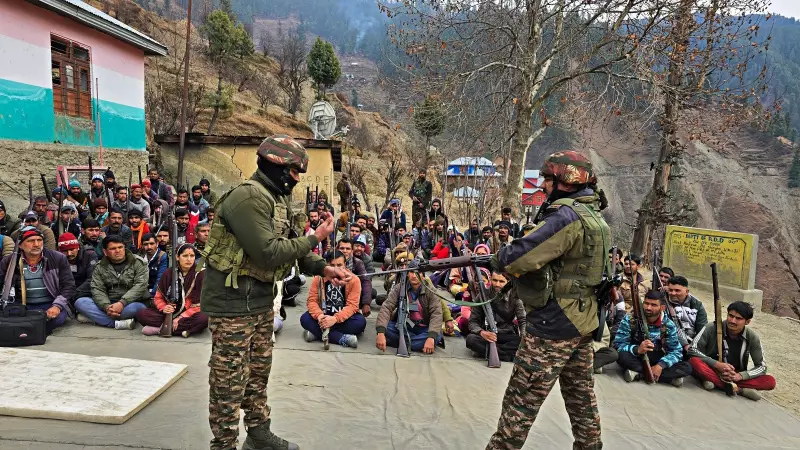
In a significant move to bolster grassroots security, Indian security forces have conducted intensive arms and tactical training for nearly 150 Village Defence Guards (VDGs) in the remote Shingani Panchayat of Jammu and Kashmir's Doda district. The three-day camp, which concluded on December 30, 2025, is part of a multi-pronged winter strategy to counter terrorist threats in the mountainous region.
Hands-On Training in Remote Terrain
Gathered at a government school, VDGs from 17 remote villages received hands-on instruction from Army personnel. The training module was comprehensive, covering the handling of automatic weapons, constructing sandbag bunkers, and conducting forest patrols. Instructors provided detailed, step-by-step guidance, from operating weapon mechanisms to troubleshooting firearm jams. Notably, women VDGs were also actively involved in the practical drills, including weapon disassembly and reassembly exercises.
The location is strategic. These villages, situated roughly 90 km from Doda town, were among the worst-hit during the peak of militancy in the mid-1990s in the Chenab Valley. The training aims not only to prepare residents for potential terrorist attacks but also to equip them with jungle warfare techniques crucial for their daily lives, as they often traverse dense forest areas.

A Coordinated Winter Security Strategy
This camp in Doda is not an isolated effort. Similar programs are being rolled out across the Jammu province by police and security forces. The strategy is designed to capitalize on winter conditions when heavy snow restricts terrorist movement, making it an opportune time to flush out and neutralize militants hiding in mid-altitude forests.
Doda Senior Superintendent of Police (SSP) Sandeep Mehta highlighted the proactive posture, stating that operational police teams have been braving icy conditions and occupying mountain tops for the past eight months to monitor terrorist movement. This sustained presence, he credited, is a key factor in the current peace in the district. In neighbouring Kishtwar, combined Army and police teams have intensified combing and search operations.
Recent months have seen a series of such initiatives:
- Weapons and battle drill training for VDGs in Samba district's Purmandal area last month.
- Border Security Force (BSF)-led training programs in the border areas of Akhnoor and Arnia.
- A comprehensive session for nearly 100 VDGs at Jammu's Sunjwan Police Firing Range in June 2025, covering firing skills and security protocols.
From VDCs to VDGs: An Evolving Framework
The current VDG scheme has its roots in the Village Defence Committees (VDCs) established by the Union Home Ministry in 1995, following a surge in terrorist violence in the erstwhile Doda district. The scheme was later expanded to other Jammu regions as militancy spread.
However, after allegations of intimidation and atrocities by some VDC members, successive governments began disbanding them. With the recent resurgence of terror activities in Jammu province, the Home Ministry in March 2022 approved a revamped scheme, rebranding the groups as Village Defence Guards (VDGs).
The new framework offers significant upgrades:
- Better Armament: VDGs are now provided with Self-Loading Rifles (SLRs), a step up from the older .303 rifles given to VDCs.
- Improved Remuneration: Each VDG member receives a monthly honorarium of Rs 4,000 to Rs 4,500, compared to the earlier model where only Special Police Officers (SPOs) within VDCs got Rs 1,500.
Under the close supervision of experienced Army instructors, these training sessions are fundamentally reshaping local defence capabilities. The objective is clear: to create a skilled, motivated, and equipped force of VDGs who can effectively assist security forces in safeguarding some of India's most sensitive and vulnerable regions.