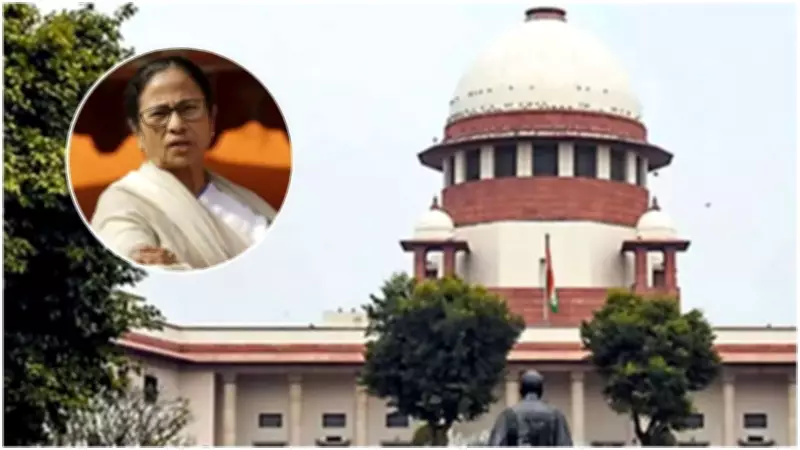
Supreme Court Grills West Bengal Government Over ED Officers' Rights in Mamata Banerjee Raid Case
The Supreme Court on Tuesday sharply questioned the West Bengal government regarding its objection to the maintainability of the Enforcement Directorate's plea. The ED alleges obstruction by Chief Minister Mamata Banerjee during a January 8 raid at I-PAC, with the court emphasizing the fundamental rights of individual ED officers involved in the incident.
Court Focuses on Officers as Citizens, Not Just Agency Members
A Bench comprising Justices Prashant Kumar Mishra and N V Anjaria highlighted that some ED officers had approached the court in their personal capacity. The justices pointedly asked whether these officers cease to be citizens of India merely because they serve in the agency. This line of questioning challenged the state's argument that the ED, as an institution, cannot file a petition under Article 32 of the Constitution.
During the hearing, Justice Mishra urged the state to concentrate on the officers' rights, stating, "Please concentrate on the fundamental rights of the officers of the ED with whom the offence has been committed. Otherwise, you will miss the point. You can’t forget the second petition which is preferred by individual officers who are the victims of the offence." The court further posed a hypothetical scenario about political dynamics, asking how the state would react if a chief minister from an opposing party engaged in similar actions in the future.

Legal Arguments on Statutory Duty vs. Fundamental Rights
Senior advocate Kapil Sibal, representing Mamata Banerjee, argued that obstruction in performing a statutory duty does not equate to a violation of fundamental rights. He contended that ED officers have only a statutory right to investigate under the Prevention of Money Laundering Act (PMLA), not a fundamental right. Sibal asserted, "Any obstruction in performance of a statutory duty is not in violation of a fundamental right. If someone obstructs a police officer, he can’t file a 32 petition. There is a statutory remedy."
However, the Bench countered this by questioning the practical remedy available to ED officers if they cannot approach the Supreme Court or High Courts. Justice Mishra asked, "If the CM barges into an ED investigation and commits an offence, your idea of remedy for the ED is to go to the state government which is headed by the CM and inform them about it and seek remedy?" Sibal responded by cautioning against presuming guilt, to which the court clarified it was only referencing the allegations in the plea.
Rejection of Election-Related Deferral and Case Background
The Supreme Court firmly rejected a suggestion to postpone the hearing due to upcoming West Bengal Assembly elections. Justice Mishra stated, "We don't want to be party to election, we don't want to be party to any crime also. We know the timing of the court. We know the timing of the decision." The hearing remained inconclusive and is scheduled to continue on April 14.
The case stems from a January 8 raid by the ED at the I-PAC office and the residence of its director Pratik Jain, linked to a money laundering probe into an alleged coal-pilferage scam. The agency claims Mamata Banerjee entered the premises during the search, removing documents and electronic devices she said belonged to her political party. The ED has sought a CBI investigation and challenged FIRs filed against its officers in West Bengal.
Earlier Developments and State's Position
On January 15, the Supreme Court had termed the obstruction allegations as "very serious" and issued notices to Mamata Banerjee, the West Bengal government, and police officials. The court also stayed the FIRs against ED officers and directed preservation of CCTV footage from the raid.
The West Bengal government has consistently argued that the ED's petition under Article 32 is not maintainable, as it can only be filed by citizens alleging fundamental rights violations. The state warned that allowing a central agency to sue a state government could endanger the federal structure, maintaining that the searches were not obstructed based on the ED's own records.