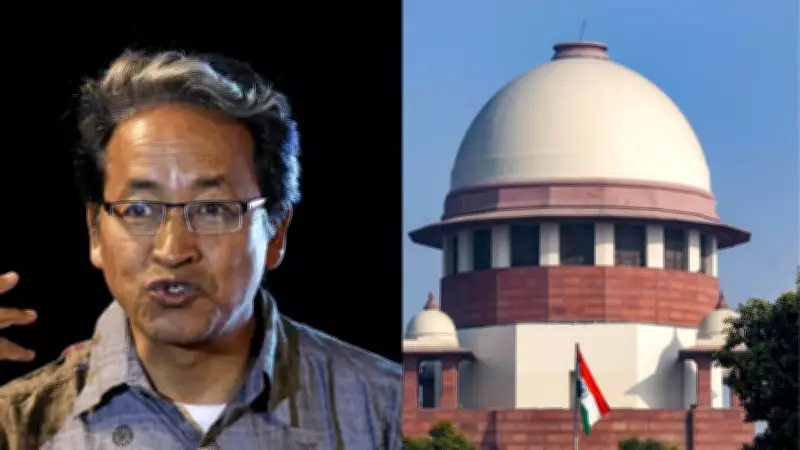
Supreme Court Questions Centre Over AI-Era Transcript Accuracy in Wangchuk Detention Case
The Supreme Court on Monday raised serious concerns with the Centre regarding the accuracy of video transcripts submitted against detained climate activist Sonam Wangchuk, emphasizing that translations must be precise, particularly "in the era of Artificial Intelligence." A bench comprising Justices Aravind Kumar and PB Varale directed the government to place on record the actual transcripts of Wangchuk's speeches for judicial scrutiny.
Discrepancies in Translated Material
Senior advocate Kapil Sibal, representing Wangchuk's wife Gitanjali Angmo, argued that certain statements attributed to the activist were never made by him. He questioned the authenticity of the translated material presented to the court, stating, "Wangchuk continued his strike and also continued to provoke youth by taking reference of Nepal. Where is this line coming from? This is a very unique detention order — you rely on something that does not exist and then you say it is based on subjective satisfaction."
Addressing Additional Solicitor General KM Nataraj, the bench remarked, "Mr Solicitor, we want an actual transcript of the speech. What he relied upon and what you say are different. We will decide. There should be an actual transcript of what he says. You may have your reasons." The court further observed, "At least, whatever he stated, the true translation should be there. Your translation goes on for 7 to 8 minutes, but the speech is for 3 minutes. We are in the era of Artificial Intelligence; precision is at least 98 per cent for translation."
Government's Response and Legal Context
In response, Nataraj informed the bench that a separate department prepares transcripts, adding, "We are not experts in it." The matter has been scheduled for further hearing on Thursday.
The apex court is hearing a habeas corpus petition filed by Angmo, seeking a declaration that Wangchuk's detention under the National Security Act (NSA), 1980, is illegal. The NSA permits the Centre and state governments to detain individuals to prevent actions "prejudicial to the defence of India," with a maximum detention period of 12 months, though it can be revoked earlier.
Background of the Detention
Wangchuk, a prominent climate activist known for his work in Ladakh, was detained on September 26 last year, two days after violent protests in Leh over demands for statehood and Sixth Schedule status resulted in four fatalities and approximately 90 injuries. He is currently held at Jodhpur Central Jail.
Earlier hearings featured sharp exchanges between the Centre and the court. The government has justified the detention, alleging that Wangchuk made inflammatory speeches, attempted to internationalize the Ladakh issue, and drew comparisons with Chinese and Pakistani provinces. It also claimed he tried to instigate youth and referenced protests in Nepal and Bangladesh, including "Arab Spring-like agitations."
Health and Procedural Safeguards
Solicitor General Tushar Mehta previously told the bench that all procedural safeguards under the NSA were "scrupulously complied with" and that Wangchuk was being treated fairly in jail. "This court is dealing with a person who is instigating people in a border area, adjacent to Pakistan and China, where regional sensitivity is involved," Mehta stated.
On health concerns, Mehta reported that Wangchuk had been medically examined 24 times since his detention, adding, "We have examined his health periodically 24 times. He is fit, hale and hearty. He had some digestive issues; he is being treated. There is nothing to worry about, nothing alarming. We can't make exceptions like this." He further asserted, "The grounds on which the detention order was passed continue. It will not be possible to release him on health grounds. It may not be desirable either. We have given utmost consideration."
Defense Arguments and Previous Court Directives
Angmo has countered that the violence in Leh on September 24 cannot be attributed to Wangchuk's actions or statements. She informed the court that Wangchuk condemned the violence on social media, describing it as the "saddest day" of his life and stating it would undermine Ladakh's peaceful "tapasya" of five years.
In prior proceedings, the Supreme Court asked the Centre if there was any possibility of reconsidering the detention and directed authorities to submit the original detention file. The court also ordered that Wangchuk be examined by a specialized doctor, with the medical report to be provided for review.