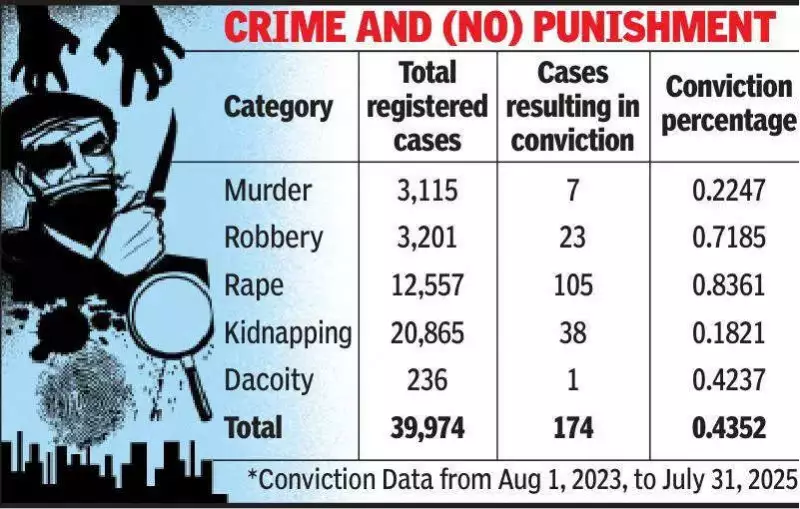
In a revelation that has sent shockwaves through Rajasthan's political and judicial circles, the state government has admitted to an alarmingly low conviction rate for serious criminal offences. Official data shows that out of 39,974 serious crimes registered over a two-year period, a paltry 174 resulted in convictions, marking a prosecution success rate of just 0.4%.
A Systemic Failure in Justice Delivery
The damning figures were part of a written reply issued by the government on Friday in response to a question raised by Kishanpole MLA Amin Kagzi. The period under scrutiny spans from August 2023 to July 2025. Reacting strongly to the statistics, Congress MLA Kagzi stated that these numbers cast serious doubt on the competence of the state's entire law-and-order machinery.
Kagzi argued that the abysmal rate raises fundamental questions about the quality of police investigations, evidence handling, timely filing of chargesheets, and ultimately, the prosecutorial ability to secure convictions in court. He described the data as evidence of systemic failures, demanding urgent and comprehensive reforms.

Jaipur Emerges as Crime Epicentre, Specific Categories Alarming
The data provides a grim breakdown, highlighting specific categories of heinous crimes. In cases of rape, which numbered 12,557, the conviction rate was negligible. Similarly, for abduction cases, which were a staggering 20,865, convictions were almost non-existent. The figures firmly establish Jaipur as the epicentre of major crimes in Rajasthan.
When case numbers from all five police districts of the capital are combined—294 in North, 512 in South, 623 in East, 581 in West, and 389 in Rural—the city's cumulative crime load significantly surpasses any other region in the state. Jodhpur ranks a distant second, with other districts like Bhilwara, Udaipur, and Bikaner also recording high levels of serious crimes.
Political Fallout and Government's Defence
Launching a scathing attack on the Bhajan Lal Sharma-led government, MLA Amin Kagzi said, "These numbers are not just statistics; they constitute evidence against a government that has abandoned its responsibilities." He added, "Under Chief Minister Bhajan Lal Sharma, criminals feel protected, and victims feel powerless. When 99.5% of serious crime cases do not end in conviction, it reveals a collapse of governance at the very top."
The government's reply also acknowledged that justice was delayed or denied in at least 16 serious crime cases due to police apathy or weak investigation. Punitive action was initiated against 24 police officers for negligence in these matters. In its defence, the government outlined steps taken to strengthen law enforcement, including expanding the police force, integrating modern technology, and installing over 12,000 CCTV cameras under the Abhay Command Centre project. It also mentioned creating special crime units and upgrading surveillance infrastructure across police stations.
However, these measures stand in stark contrast to the ground reality reflected in the conviction data. The disclosure has ignited a fierce debate on public safety and judicial efficacy in Rajasthan, with calls for immediate intervention to restore faith in the criminal justice system.