In a significant ruling that reinforces the balance between religious freedom and public peace, the Nagpur bench of the Bombay High Court on Monday dismissed a petition seeking permission to use loudspeakers at a mosque in Gondia. The court firmly stated that using loudspeakers is not an essential part of practising any religion.
Court Cites Supreme Court Precedent on Noise Pollution
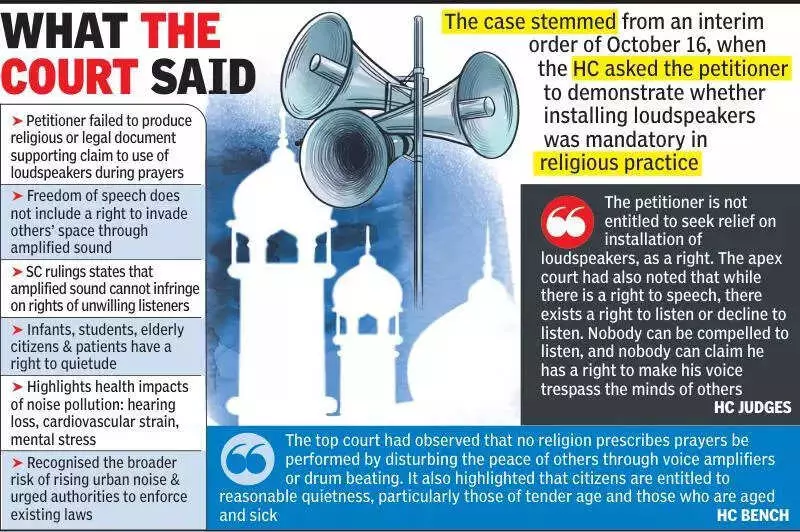
The division bench, comprising Justices Anil Pansare and Raj Wakode, based its decision on earlier rulings by the Supreme Court of India. The judges quoted the apex court's observation that no religion prescribes that prayers must be performed by disturbing others' peace through voice amplifiers or drum beating. The bench emphasized that citizens have a fundamental entitlement to reasonable quietness, a right particularly crucial for the elderly, the sick, and young children.
The case originated from an interim order passed on October 16, where the High Court had asked the petitioner, Masjid Gousiya, to demonstrate whether installing loudspeakers was mandatory in their religious practice. During the subsequent hearings, the petitioner could not produce any legal or religious document establishing a right to use loudspeakers for offering prayers. The bench concluded that the petitioner was not entitled to seek relief for installing loudspeakers as a matter of right.
The Right to Speak vs. The Right to Not Listen
The judges elaborated on a key constitutional principle highlighted by the Supreme Court. While there exists a fundamental right to freedom of speech, there equally exists a right to listen or to decline to listen. Nobody can be compelled to listen, and nobody can claim a right to make his voice trespass into the minds of others, the bench noted. The freedom of speech, therefore, cannot be stretched to force unwilling listeners to hear amplified sound.
The court also detailed the serious public health implications of noise pollution. It referred to the Noise Pollution (Regulation and Control) Rules, 2000, framed under the Environment (Protection) Act, 1986. The judgment cited the well-documented health threats posed by excessive noise, including increased cardiovascular risks and mental stress. The bench acknowledged that while states have limited exemptions under these rules, such permissions cannot be arbitrarily expanded in duration or the number of days.
A Ruling with Wider Implications for Urban India
Observing that the issue demanded wider attention, the judges used this specific case to underline the larger public health threat posed by unchecked sound pollution across India's urban spaces. The dismissal of the mosque's petition, the court clarified, does not detract from the equally important need for authorities to ensure responsible and consistent enforcement of noise-control laws for all.
This ruling by the Nagpur bench reinforces the legal framework that prioritizes communal harmony and public health, establishing that the use of technology like loudspeakers for religious purposes must conform to laws designed to protect the peace and well-being of all citizens.