Maharashtra Enacts Anti-Conversion Legislation, Joining 12 Other States
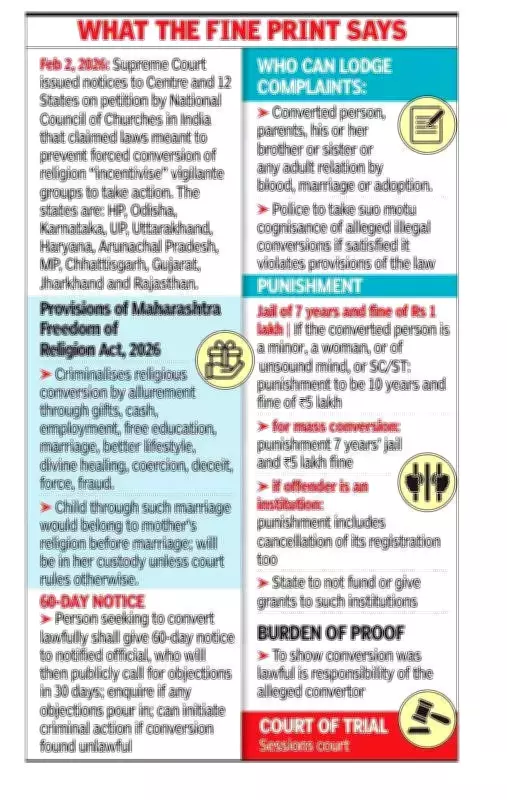
Mumbai: The state of Maharashtra has officially passed a bill to prohibit unlawful religious conversions, becoming the thirteenth state in India to enact such legislation. The Maharashtra Freedom of Religion Act, 2026, was approved by both houses of the State legislature on March 17 and 18, respectively. It now awaits the Governor's formal assent and subsequent gazette notification before coming into full legal force.
Key Provisions and Historical Context
Modeled after similar laws in other states, the Maharashtra Act mandates that individuals provide a 60-day advance notice to a district magistrate before converting to another religion. This measure aims to criminalize conversions based on coercion, fraud, or marriage predicated on allurement or deceit. The legislative move follows a historical pattern, with Odisha pioneering such laws in 1968, followed by Madhya Pradesh and several other states over the decades.
Legal Challenges and Constitutional Concerns
Senior counsel and former additional solicitor general Indira Jaisingh has urged the Maharashtra government to exercise political prudence by awaiting a pending Supreme Court judgment before notifying the law. A challenge to anti-conversion laws from multiple states is currently before the Supreme Court and has been listed on the daily board for consideration. Jaisingh emphasized that proceeding with notification could be perceived as disrespectful to the court, especially concerning serious violations of fundamental rights, including the right to marry a person of one's choice.

On February 2, a Supreme Court bench comprising Chief Justice Surya Kant and Justice Joymala Bagchi issued notices to the Central government and twelve states in response to a petition filed by the National Council of Churches in India. The petition argues that these laws inadvertently encourage vigilante groups and questions their constitutional validity. This matter is now pending before a three-judge bench of the Supreme Court, adding a layer of judicial scrutiny to the issue.
Expert Opinions and Potential for Misuse
Prominent civil rights defender and senior counsel Mihir Desai has indicated that the Maharashtra Act may face legal challenges in the Supreme Court. Desai criticized the law's wording, noting that it inaccurately labels itself as promoting 'freedom of religion' when it actually imposes prior notice and approval requirements from authorities, even for conversions based purely on personal conscience.
Legal experts have raised concerns about the broad-based interpretation of terms such as 'allurement' and 'undue influence' within the Act. Desai and other lawyers argue that these vaguely defined terms could be susceptible to misuse, potentially leading to arbitrary enforcement. Former Bombay High Court judge Justice (retired) B.H. Marlapalle clarified that for criminal action to be valid, allegations must be specific, contrasting with the broad terminology used in the legislation, which includes concepts like 'divine healing', 'brainwashing', and 'undue influence'.
Controversial Provisions and Social Implications
The bill includes a contentious provision regarding children born from marriages deemed solely for 'unlawful conversion'. In such cases, the child would be considered to belong to the mother's pre-marriage religion, with the mother retaining custody unless a court decides otherwise. Reactions to this clause are divided among lawyers and activists; some view it as progressive, while others label it divisive and potentially infringing on the child's rights.
Ministers in Maharashtra defend the legislation as necessary to ensure that religious conversions are voluntary, transparent, and free from force or fraud. They cite increasing instances of forceful conversions that threaten social harmony and reference Supreme Court orders affirming that reasonable restrictions can be applied. The bill explicitly states that the right to freely profess, practice, and propagate religion under Article 25 of the Constitution does not include the right to forcibly convert others.

Constitutional Mandate and Future Outlook
Legal experts highlight the constitutional mandate under Article 25, which protects an individual's right to practice, profess, and propagate faith. The ongoing Supreme Court proceedings will likely test the validity of the Maharashtra Act and similar laws across India. As the state moves forward with implementation, all eyes are on the judicial outcomes that could shape the future of religious freedom and conversion laws in the country.