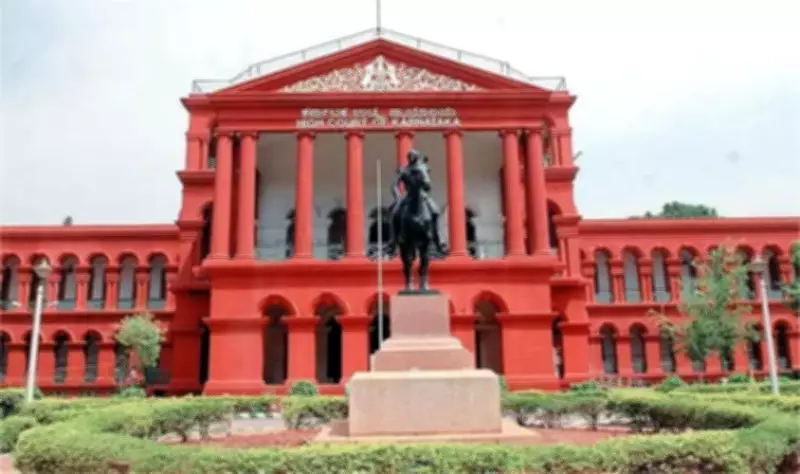
Karnataka High Court Clarifies Law on Statutory Bail and Chargesheet Filing
The Karnataka High Court has delivered a significant ruling stating that the filing of a chargesheet without accompanying documentation such as Call Detail Records (CDR) and Forensic Science Laboratory (FSL) reports does not strip it of its legal character as a final report. Furthermore, such an omission does not revive or confer upon an accused the right to claim statutory bail under the law.
Court Dismisses Bail Petition in Sensitive Pocso Case
Justice M Nagaprasanna recently dismissed the bail petition filed by a 27-year-old man, who works as housekeeping staff at a private hospital in Bengaluru. The accused is alleged to have had a physical relationship with a female colleague despite knowing she was underage. The girl was later found to be pregnant when she died by suicide.
Following a complaint by the victim's mother, an FIR was registered for offences punishable under various sections of the Bharatiya Nyaya Sanhita (BNS), the Scheduled Castes and Scheduled Tribes (Prevention of Atrocities) Act, and the Protection of Children from Sexual Offences (Pocso) Act. On December 23, 2025, a special court refused to grant default bail to the accused, leading to his challenge in the high court.

Legal Arguments and Judicial Interpretation
The accused contended that Section 193(2) of the Bharatiya Nagarik Suraksha Sanhita (BNSS) mandates that a chargesheet must be filed within 60 days for the invoked sections. He argued that, in accordance with sections 187(3)(ii) and 193(2) of BNSS, the concerned court should have granted him statutory bail. He further submitted that the chargesheet filed by the police was incomplete, lacking an FSL report, DNA report, CDRs, or retrieval of mobile phone contents.
In contrast, the police argued that a defective or incomplete chargesheet does not entitle the petitioner to statutory or default bail. After a thorough perusal of the materials on record, Justice Nagaprasanna noted that, as per Supreme Court precedent, once a chargesheet is filed within the stipulated period with all material except additional reports, the right to statutory bail is extinguished.
Key Observations on Investigative Process
Justice Nagaprasanna emphasized that the criminal process is not a ritual of perfection at its inception. "It is an evolving inquiry where additional evidence may surface in the fullness of time. To insist upon absolute completeness at the stage of filing of chargesheet would be to impose an impracticable burden upon the investigative machinery," the judge observed.
The court clarified that Section 193(2) of BNSS, which mandates filing a chargesheet within 60 days for certain offences, is intended to ensure the completion of investigation in sensitive cases like rape and Pocso. "It is at best for the benefit of the survivor," Justice Nagaprasanna pointed out, adding that this provision cannot be exploited by an accused seeking statutory or default bail.
This ruling reinforces the judiciary's stance on balancing investigative practicality with legal rights, ensuring that procedural gaps do not unduly benefit those accused of serious crimes.