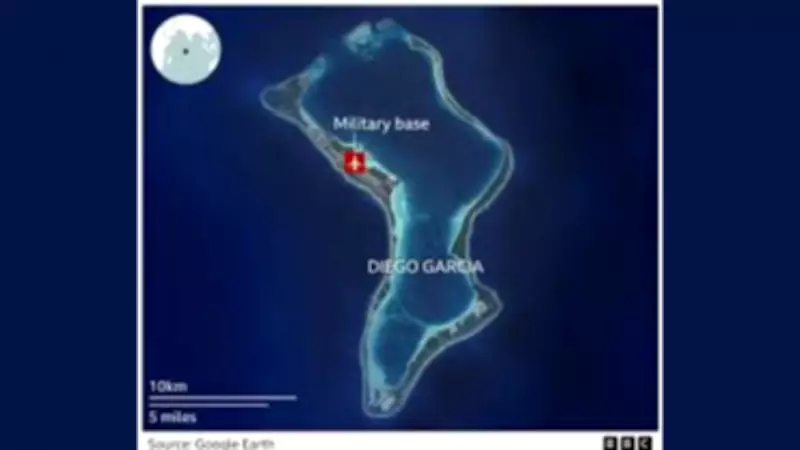
Iran's Missile Test Targets Strategic Diego Garcia Base in Indian Ocean
The escalating tensions between Iran and Israel-US have now extended into India's maritime backyard, with Tehran launching two ballistic missiles toward the strategically vital Diego Garcia military base in the Indian Ocean. This joint US-UK facility, located approximately 4,000 kilometers from Iran, represents a critical power projection hub for Western forces across West Asia, South Asia, and the Indo-Pacific region.
Failed Attack Highlights Iran's Missile Ambitions
According to foreign agencies quoting UK officials, the Iranian missiles failed to hit their intended target. One projectile reportedly malfunctioned during its flight trajectory, while the other was engaged by a US naval interceptor system. The Pentagon has declined to comment on whether this second missile was successfully destroyed, leaving questions about the precise outcome of the engagement.
Defense analysts suggest this incident represents more than a simple military provocation. Iran may have been testing an Intermediate-Range Ballistic Missile system, attempting to demonstrate its capacity to strike targets deep within the Indian Ocean basin. The Iranian state-affiliated Mehr news agency described the operation as a "significant step" that "shows that the range of Iran's missiles is beyond what the enemy previously imagined."

Strategic Importance of Diego Garcia
Diego Garcia serves as a crucial linchpin in global military operations with capabilities that include:
- An extensive airfield with runways capable of accommodating B-52 bombers, KC-135 tankers, reconnaissance aircraft, and large transport planes
- Major fuel storage facilities and radar installations supporting regional military operations
- A deep-water port that can dock, resupply, and maintain aircraft carriers, destroyers, and submarines
The base's strategic positioning—approximately 3,000 kilometers from both the Bab-el-Mandeb Strait at the Red Sea's entrance and the Malacca Strait near the South China Sea—makes it essential for monitoring activities of US rivals like China and safeguarding critical global trade routes.
Diplomatic Tensions Escalate
This missile test occurred against a backdrop of heightened diplomatic friction. Iranian Foreign Minister Abbas Araghchi recently warned his UK counterpart, British Home Secretary Yvette Cooper, that any American use of British military bases to attack Iran would be considered "participation in aggression." The UK government responded firmly, with Cooper cautioning Araghchi "against targeting UK bases, territory or interests directly."
The timing is particularly significant as the UK has recently permitted the United States to utilize its military installations for potential operations against Iran. This failed missile attack on Diego Garcia appears designed to create strategic ambiguity about Tehran's actual strike capabilities, thereby gaining diplomatic leverage by keeping adversaries uncertain about its true military reach.
Historical Context and Global Implications
Diego Garcia has served as a critical launchpad for major US military campaigns, including the 1991 Gulf War and 2003 Iraq War, where it facilitated high-volume air operations. Today, the base continues to enable rapid air and naval deployment across the ocean, helping the United States project power, deter potential adversaries, and reassure regional allies.
This incident has drawn global attention not only because of the base's strategic importance but also for what it reveals about Iran's evolving missile technology. Over twenty nations have already issued a joint statement condemning Iran's de facto closure of the Hormuz Strait, indicating that regional tensions are reaching new heights with implications for international security and trade.