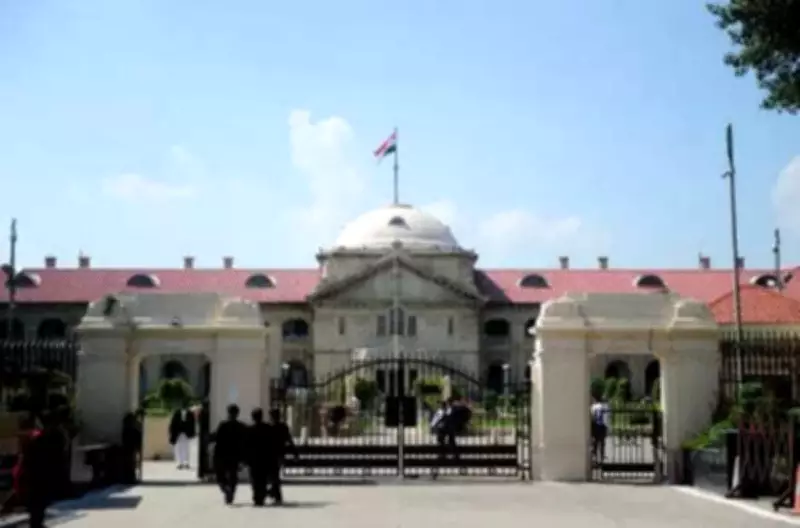
Allahabad High Court Scrutinizes Uttar Pradesh Government Over Continued Punitive Demolitions
The Allahabad High Court has made a significant observation that punitive demolitions of structures are persisting across Uttar Pradesh, despite a landmark Supreme Court ruling from November 2024 that explicitly declared 'bulldozer justice' as unacceptable under the rule of law. This critical stance emerged during a recent hearing, where the court expressed deep concern over the ongoing practices that appear to flout the apex court's directives.
Court Questions State Government's Actions and Executive Discretion
A division bench comprising Justices Atul Sreedharan and Siddharth Nandan pointedly questioned the state government, asking whether demolishing a structure immediately following the commission of an offence constitutes a colourable exercise of executive discretion. The bench noted that it has encountered multiple cases where demolition notices were issued to occupants right after they were accused of offences, with their dwellings subsequently razed after what seemed like a mere procedural formality.
In light of these instances, the high court emphasized the overarching nature of the issue, which pits the state's authority to demolish structures against the fundamental rights of citizens under Articles 14 (right to equality) and 21 (right to life and personal liberty) of the Constitution. To address this complex legal conflict, the court has framed five pivotal questions of law for the involved parties to deliberate upon.
Key Legal Questions Framed by the High Court
The court's inquiries delve into the heart of the matter, seeking clarity on several critical aspects:
- Is there non-compliance with the Supreme Court's November 2024 judgment, particularly referencing paragraphs 85 and 86 of that order?
- Does the authority to demolish justify the act of razing a structure, or does the state have a duty to refrain from demolishing dwelling places in the absence of a genuine public need or purpose?
- Are steps taken to demolish a structure immediately after an offence is committed a colourable exercise of executive discretion?
- How can the High Court balance the conflicting interests between the state's statutory authority to demolish and the fundamental rights of average citizens under Articles 21 and 14 to prevent such actions?
- Can a reasonable apprehension of demolition serve as a valid cause of action for citizens to approach the court, and if so, what constitutes the bare minimum for the court to acknowledge such apprehension?
Background of the Case and Petitioners' Allegations
These observations were made during the hearing of a writ petition filed on January 21 by Faimuddeen and others. The petitioners claimed that their relative, Aafan Khan, was named in an FIR under various sections of the BNS, Pocso Act, IT Act, and the UP Prohibition of Unlawful Religious Conversion Act. They alleged that, despite not being co-accused in the FIR, they were targeted by a mob allegedly in collusion with the police.
The petitioners raised a reasonable apprehension that their properties in Hamirpur—including a residential house, a commercial lodge, and a saw mill—had been marked for demolition. They further stated that the commercial lodge and saw mill had already been sealed, prompting them to seek the High Court's intervention to prevent any further demolition actions.
State Government's Response and Court's Decision
In response, the state government raised a preliminary objection, arguing that the petition is premature and that the petitioners should first respond to the notices issued to them. Additionally, an oral assurance was given to the High Court that no demolition would occur without following the established legal procedure and without providing the petitioners a due opportunity to present their case before the concerned authorities.
However, the high court, noting that such demolitions have continued in the state despite the Supreme Court's order, deemed it appropriate to address the framed questions. The matter is now scheduled for further hearing on February 9, where these critical legal issues will be examined in depth.